Cobra Effect · Maths and proof
Some infinities are bigger than others
How Georg Cantor showed that some infinities are larger than others.
7 cards, read aloud in 2:40, with a test and sources.
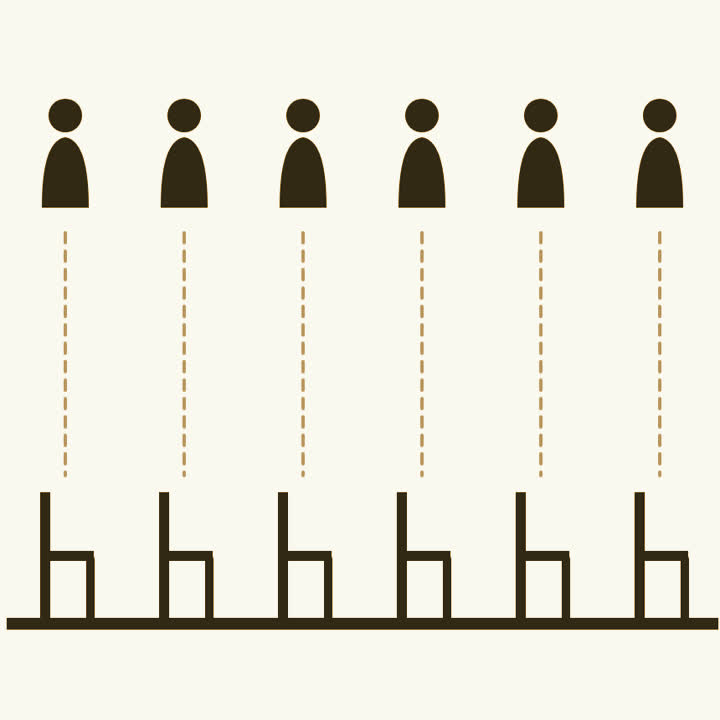
Two collections are the same size if their members can be paired off exactly.
You can tell a room has as many chairs as people without counting, if every person has exactly one chair. The German mathematician Georg Cantor applied this simple idea to infinite collections. His results astonished, and troubled, many mathematicians.
Some infinite collections that look different turn out to be the same size.
The even numbers can be paired with all the whole numbers, two with one, four with two, and so on. Every even number gets a partner, and no number is left over. Collections that can be listed like this are called countable.
In 1874, Cantor published a surprising result.
He showed that the algebraic numbers, a huge family that includes every fraction and many roots, can be listed. But the real numbers, all the points along a line, cannot. So there are more real numbers than whole numbers, even though both are endless.
Around 1891, he found a simpler and now famous proof.
Suppose someone claims to have listed every number between zero and one, written as endless decimals. Build a new number by changing the first digit of the first number, the second digit of the second, and so on down the list. The new number differs from every number on the list, so the list was never complete.
The same idea showed that there is no largest infinity.
Cantor proved that the collection of all the subsets of a set is always larger than the set itself. So from any infinity, a larger one can always be built. Infinity turned out to come in an endless ladder of sizes.
Not everyone welcomed these ideas.
The influential mathematician Leopold Kronecker was deeply suspicious of Cantor’s work. Cantor suffered from recurring depression, and spent periods in sanatoriums. He died in 1918. In the 1920s, David Hilbert declared that no one would drive mathematicians out of the paradise Cantor had created.
So when two things are both endless, ask whether they can really be matched up.
Endless does not mean equal. Cantor found a precise way to compare infinities, by pairing. A simple idea, followed carefully, can open up a whole new world.
Sources
- The Early Development of Set Theory, Stanford Encyclopedia of Philosophy. Cantor’s results and how they were received.
- Georg Cantor, MacTutor History of Mathematics. A biography of Cantor.
- Uber das Unendliche, David Hilbert, Mathematische Annalen, 1926. The address in which Hilbert defended Cantor’s paradise.
Nearby ideas
- The primes never run out. How a proof over two thousand years old shows the primes never run out.
- The question no machine can answer. How Alan Turing imagined the computer, and proved some questions have no answer.
- The limits of proof. How Kurt Godel found limits that no system of proof can escape.
- The margin that was too small. How Andrew Wiles proved Fermat's three hundred year old claim.
- The long journey of zero. How zero grew from a gap in a number into a number in its own right.
- Seven bridges and a walk that could not be done. How Euler proved a walk impossible without trying a single route.