Cobra Effect · Maths and proof
The long journey of zero
How zero grew from a gap in a number into a number in its own right.
7 cards, read aloud in 2:38, with a test and sources.
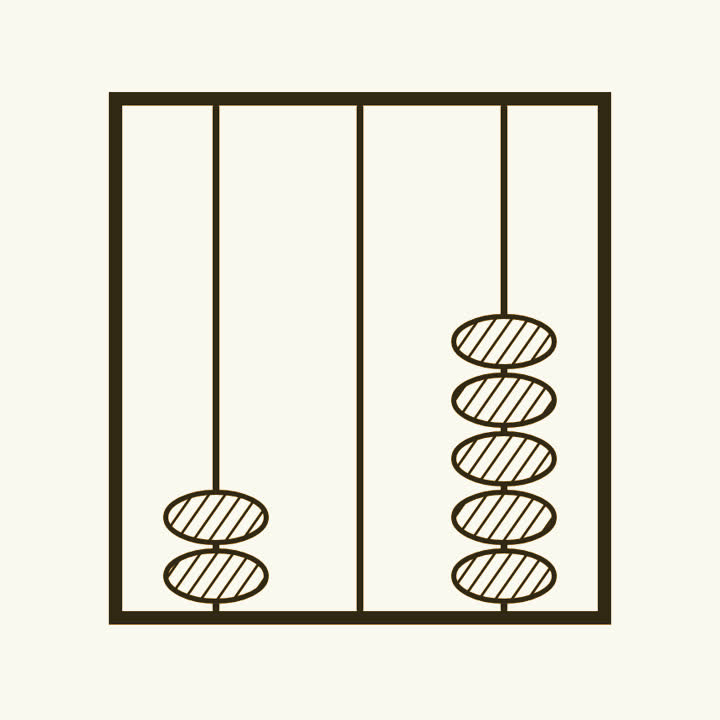
Writing large numbers needs a way to show an empty place.
In our system, the zero in 205 shows that there are no tens. Without it, 205 and 25 would look the same. For thousands of years, people managed without such a sign.
By about four hundred BC, the Babylonians were marking empty places.
They wrote numbers with wedge shapes pressed into clay. Two small slanted wedges showed a gap inside a number. But they never wrote it at the end of a number, and did not treat it as a number in itself.
The Maya, in Central America, invented a zero of their own.
They counted in twenties, and used a sign often drawn like a shell for an empty place. They used it in their calendar calculations. Nobody is sure exactly when their zero first appeared.
In India in 628, the astronomer Brahmagupta wrote rules for calculating with zero.
A number plus zero stays the same, and a number times zero becomes zero. He treated zero as a number in its own right, not just a gap. He also said that zero divided by zero is zero, which mathematicians today reject.
An old Indian manuscript made headlines in 2017.
The Bakhshali manuscript, written on birch bark, uses a dot for zero. Radiocarbon dating suggested one part was as old as the third or fourth century. But other samples were centuries younger, and historians dispute what the dates mean.
The oldest dated zeros carved in stone come from Southeast Asia and India.
A stone inscription from Cambodia, dated to the year 683, is reported to write its date with a dot for zero. A temple inscription at Gwalior in India, from 876, uses a small circle. In 1202, Fibonacci’s book Liber Abaci helped bring these numerals, zero included, to Europe.
So when an idea seems obvious, ask how long it took to discover.
Zero seems simple now, but it arrived in steps, from a gap marker to a number. Different peoples reached it separately. The most useful ideas often look obvious only after someone has worked them out.
Sources
- A history of Zero, MacTutor History of Mathematics. From Babylonian wedges to Fibonacci.
- Carbon dating finds Bakhshali manuscript contains oldest recorded origins of the symbol zero, University of Oxford, Bodleian Libraries, 2017. The announcement of the radiocarbon dates.
- The Bakhshali Manuscript: a response to the Bodleian Library’s radiocarbon dating, History of Science in South Asia, 2017. Historians explain why they doubt the early date.
Nearby ideas
- The primes never run out. How a proof over two thousand years old shows the primes never run out.
- Seven bridges and a walk that could not be done. How Euler proved a walk impossible without trying a single route.
- Some infinities are bigger than others. How Georg Cantor showed that some infinities are larger than others.
- The limits of proof. How Kurt Godel found limits that no system of proof can escape.
- The margin that was too small. How Andrew Wiles proved Fermat's three hundred year old claim.