Cobra Effect · Computing and information
The codebreakers who read Enigma
How Polish mathematicians and Bletchley Park broke Germany's Enigma machine.
7 cards, read aloud in 2:43, with a test and sources.
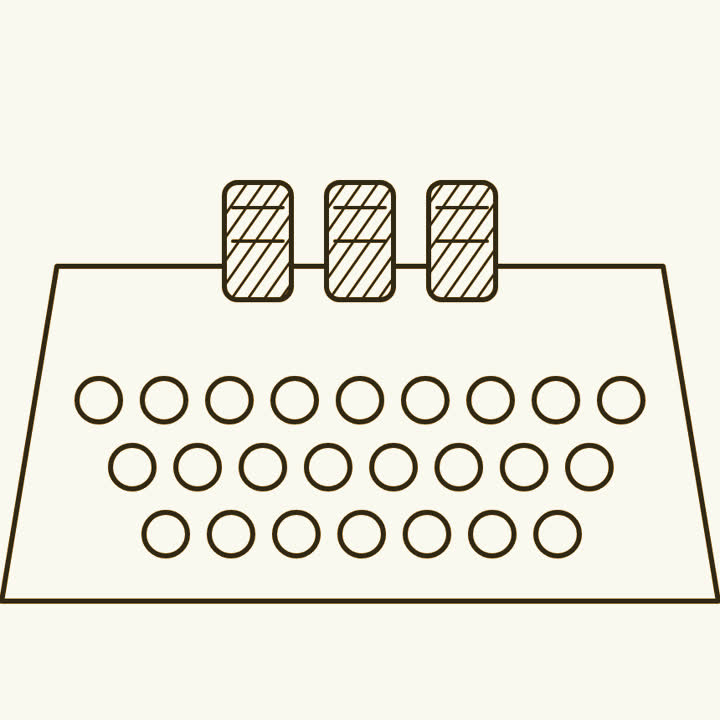
From the late 1920s, the German armed forces sent secret messages using Enigma machines.
Each key press sent electric current through a set of rotors, which scrambled the letter. The rotors moved with every key press, so the scrambling kept changing. The settings were changed regularly, giving an enormous number of possibilities.
In Poland, three young mathematicians took on the machine.
Marian Rejewski, Henryk Zygalski and Jerzy Rozycki had trained on a cryptology course for mathematics students in Poznan. In 1932, Rejewski used mathematics to work out how the military Enigma’s rotors were wired. He was helped by German documents that French intelligence had obtained and passed on.
For years, the Poles read German military messages.
They built replica machines, and invented methods and devices to find the settings. One device, called the bomba, searched through settings automatically. But in late 1938, Germany made the system more complex, and the Poles could read far less.
In July 1939, weeks before the war began, the Poles shared their secrets.
At a meeting in a forest near Warsaw, they gave British and French codebreakers replica machines and their methods. Britain’s signals agency later said that this knowledge transformed its approach to Enigma.
At Bletchley Park in England, the work grew enormously.
Alan Turing designed a machine called the bombe, which searched for settings using words expected in a message. Gordon Welchman added an improvement that made it far more powerful. Around two hundred bombes were built, run by thousands of staff, many of them women.
Naval Enigma was harder still.
In 1942, a new machine with four rotors cut Bletchley off from U-boat messages for about ten months. Captured code material and new methods eventually broke back in. One official historian judged that all this intelligence shortened the war in Europe by at least two years.
So when a problem seems beyond one team, ask who else has already made progress.
The Poles cracked Enigma years before the war. The British built on their work, and scaled it up far beyond what one small team could do. Great breakthroughs are often relays, not solo sprints.
Sources
- The Pyry forest meeting, GCHQ. How the Poles shared their Enigma work in July 1939.
- First Breaking of Enigma Code by the Team of Polish Cipher Bureau, 1932–1939, IEEE Milestones, Engineering and Technology History Wiki. A detailed account of the Polish break.
- The Turing-Welchman Bombe, The National Museum of Computing. The machine that searched for Enigma settings.
Nearby ideas
- The question no machine can answer. How Alan Turing imagined the computer, and proved some questions have no answer.
- The man who measured information. How Claude Shannon turned information into something that could be measured in bits.
- The codes that fix their own mistakes. How a frustrated mathematician invented codes that find and fix their own errors.
- The tiny switch that replaced the valve. How a slab of germanium at Bell Labs gave rise to every modern chip.
- The notes that imagined a computer. How Ada Lovelace's notes on an unbuilt machine imagined what computers could do.