Cobra Effect · Computing and information
The tiny switch that replaced the valve
How a slab of germanium at Bell Labs gave rise to every modern chip.
7 cards, read aloud in 2:30, with a test and sources.
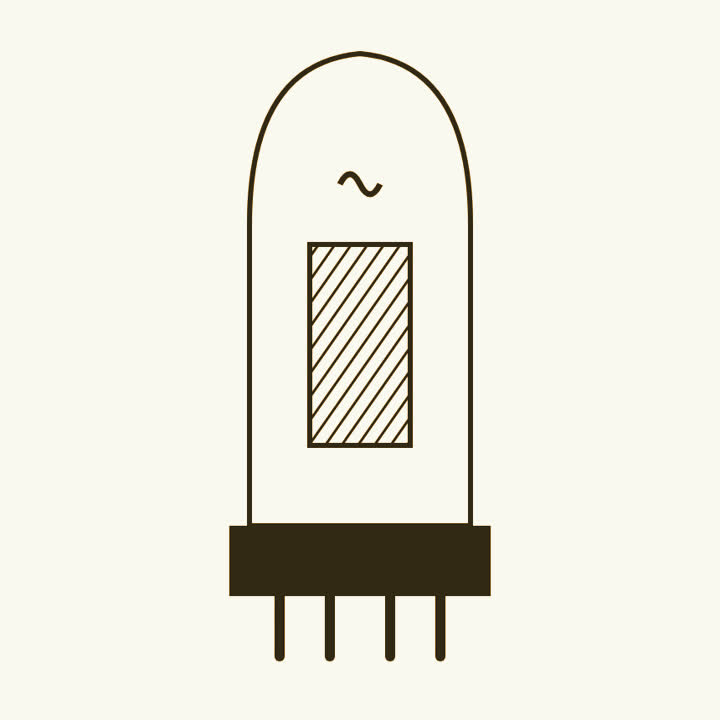
In the 1940s, electronics depended on glass valves, also called vacuum tubes.
They could amplify signals and switch currents, but they were bulky, fragile and ran hot. The telephone network needed something smaller and more reliable. At Bell Labs, a team was studying materials called semiconductors.
In December 1947, John Bardeen and Walter Brattain made a crystal amplify a signal.
They pressed two gold contacts, very close together, onto a slab of germanium. A small signal fed into one contact came out much stronger at the other. A week later, they demonstrated it to Bell Labs officials.
The device was named the transistor.
The name was coined by John Pierce, another engineer at Bell Labs. William Shockley, who led the group, called it a magnificent Christmas present. Shockley then set out to design a better version of his own.
In January 1948, Shockley conceived the junction transistor.
Instead of delicate point contacts, it used layers within the crystal itself. It was sturdier, and far easier to manufacture. Working junction transistors were made from 1950, and announced in 1951.
Bell Labs announced the transistor to the public in June 1948.
Over the following years, transistors began replacing valves in radios, hearing aids and computers. In 1956, Shockley, Bardeen and Brattain shared the Nobel Prize in Physics.
Transistors kept getting smaller.
Engineers learned to make many of them together on a single chip of silicon. A modern chip can hold billions of transistors. Every phone and computer today builds on the idea first shown on a slab of germanium.
So when a technology is bulky and fragile, ask whether another material could do the job.
Valves did their job, but at a cost in size, heat and reliability. A solid crystal could do the same work far more efficiently. Many revolutions begin with a better material, not just a better machine.
Sources
- Invention of the Point-Contact Transistor, Computer History Museum. The breakthrough of December 1947.
- Conception of the Junction Transistor, Computer History Museum. Shockley’s sturdier design of 1948.
- The Nobel Prize in Physics 1956, NobelPrize.org. The prize for the discovery of the transistor effect.
Nearby ideas
- The man who measured information. How Claude Shannon turned information into something that could be measured in bits.
- The codes that fix their own mistakes. How a frustrated mathematician invented codes that find and fix their own errors.
- The notes that imagined a computer. How Ada Lovelace's notes on an unbuilt machine imagined what computers could do.
- The question no machine can answer. How Alan Turing imagined the computer, and proved some questions have no answer.
- The codebreakers who read Enigma. How Polish mathematicians and Bletchley Park broke Germany's Enigma machine.