Cobra Effect · Statistics and probability
The gambler’s fallacy
Chance has no memory, so nothing is ever due.
6 cards, read aloud in 2:38, with a test and sources.
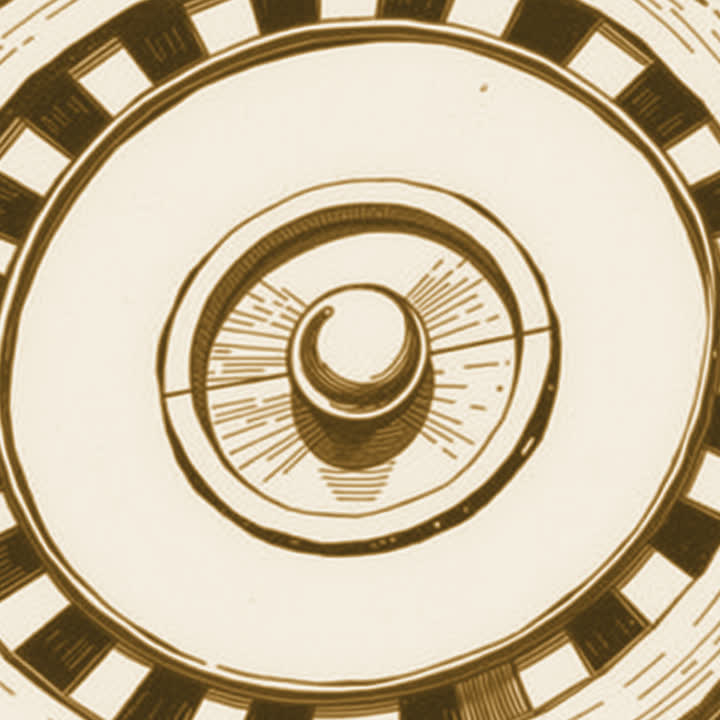
Monte Carlo, 18 August 1913. The ball lands on black. Again.
Black has come up ten times in a row at the roulette table. Then fifteen. People start pushing money onto red, because red is due. Black comes up 26 times in a row. By the end the casino has taken millions of francs from people betting on a correction.
The wheel has no memory.
Each spin is independent of the last. On a single zero wheel the chance of black is a shade under half, every time, whatever came before. A run of 26 is astonishing. Once in more than a hundred million spins. But given 25 blacks, the chance of a 26th was exactly what it always was.
That is the gambler’s fallacy.
The belief that a run of one outcome makes the opposite outcome more likely next. It feels like justice. The universe owes red a turn. But chance does not settle debts. In the long run the counts even out, not because red catches up, but because the run gets swamped by everything after it.
The story is well travelled and the records are thin.
The tale is told in many books, and the details vary with the teller. It may have happened much as told, or grown in the retelling. The arithmetic does not depend on it. People bet on red because red was due in 1913, and they do it now, with the same odds.
It is not only gamblers.
A couple with three sons is sure the next will be a girl. A pilot who has flown for years without incident feels one is due. An investor who has seen a stock fall for five days buys, because it must bounce. Some of those are wrong for this reason. Some are not, because the events are not independent. The skill is telling which.
The question that settles it.
Does this thing remember? A wheel, a coin, a lottery ball: no. The past is not a debt to be repaid. A tired pitcher, a worn tyre, a market full of people who all read the same news: maybe. If it has no memory, the run tells you nothing about the next one. Bet accordingly, or better, don’t.
Sources
- Belief in the law of small numbers, Amos Tversky and Daniel Kahneman, 1971. Psychological Bulletin. Even trained statisticians expect short runs to look like long run averages. The fallacy, measured in professionals.
- The Drunkard’s Walk, Leonard Mlodinow, 2008. How randomness rules our lives, with the casino stories and the mathematics kept gentle.
- Gambler’s fallacy, Wikipedia. The Monte Carlo night, the arithmetic, and the studies of where people expect runs to end.
Nearby ideas
- Regression to the mean. Extreme results drift back towards normal, whatever you do.
- Base rate neglect. A good test for a rare thing still gives mostly false alarms.
- The Monty Hall problem. Why switching doors wins twice as often as staying put.
- Berkson’s paradox. Filtering who you look at can create links that are not there.
- Simpson’s paradox. A trend in every group can reverse when the groups are combined.
- The law of small numbers. Small samples swing wildly, and the swings look like signals.
- The prosecutor’s fallacy. A rare match is not the same as a small chance of innocence.
- The St Petersburg paradox. A huge prize is worth less to you than its average suggests.