Cobra Effect · Statistics and probability
The Monty Hall problem
Why switching doors wins twice as often as staying put.
7 cards, read aloud in 2:46, with a test and sources.
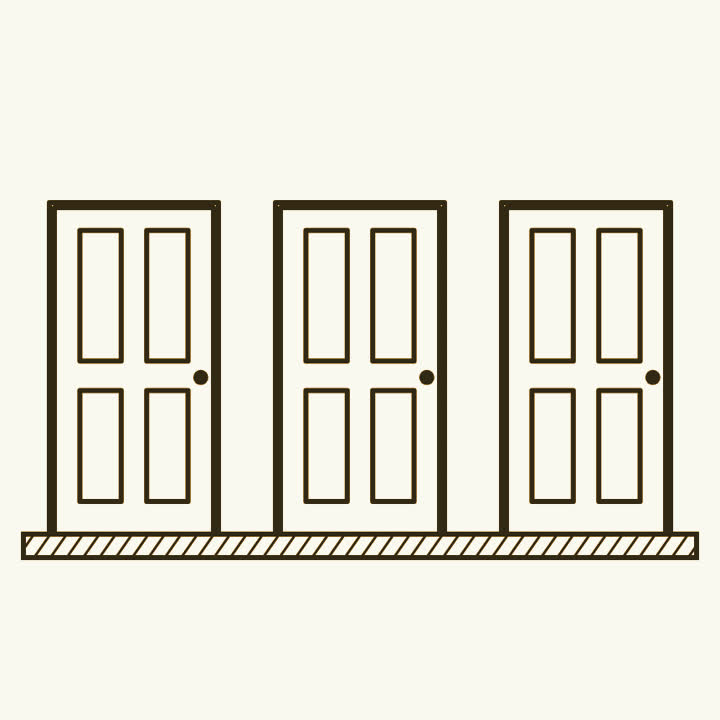
Three doors. Behind one, a car. Behind the others, goats. Pick.
The game show host knows where the car is. You choose door one. He opens door three and shows you a goat. Then he offers you a deal. Stick with door one, or switch to door two?
1990. A magazine columnist says switch. America says she is wrong.
Marilyn vos Savant answered the question in her column in Parade. Switching wins two times in three, she said. Around ten thousand letters arrived. Nearly a thousand were from people with doctorates. Most of them told her, some very rudely, that it was obviously fifty fifty.
She was right. Here is why.
When you picked door one, you had a one in three chance. That has not changed. The host was always going to show you a goat, whatever you picked. So two thirds of the time the car is behind a door you didn’t pick. And the host has just told you which of those doors it isn’t.
Still not convinced? Try it with a hundred doors.
You pick one. The host, who knows, opens 98 others, all goats. One door is left unopened, besides yours. Do you really think your first guess was as good as his?
It is called the Monty Hall problem, after the host of Let’s Make a Deal.
A statistician named Steve Selvin had posed it in 1975, and got the same argument. The catch is the host. He knows, he always opens a goat, and he always offers the switch. Change any of that and the answer changes. Even some professional mathematicians reportedly refused to believe it until they saw it run as a simulation.
The lesson is bigger than a game show.
When someone who knows the answer acts, their action is information. The host didn’t open a door at random. He opened one he knew was safe. Most of us ignore that and treat the two doors as equal. Fifty fifty is what a problem feels like when you have thrown away a clue.
So when the odds feel obvious, run it.
Marilyn told her readers to play the game at home with three cups and a coin. Schools across the country did, and the letters changed their tone. If a sum feels certain and you cannot show it, deal the cards. Twenty rounds will settle what a thousand doctorates could not.
Sources
- Monty Hall problem, Wikipedia. The 1990 column, the letters, Selvin’s 1975 version, the proofs, and every variant where the answer changes. Long, and the arguments on its talk page are legendary.
- The Drunkard’s Walk, Leonard Mlodinow, 2008. A readable history of probability with a chapter on the three doors and why even mathematicians fought it. Good on how randomness fools us in daily life.
- Marilyn vos Savant, Wikipedia. The columnist, the column, and the affair of the letters, including some of the choicer quotes from the people who wrote to tell her she was wrong.
Nearby ideas
- Base rate neglect. A good test for a rare thing still gives mostly false alarms.
- The birthday problem. Coincidences are far more likely than they feel.
- The gambler’s fallacy. Chance has no memory, so nothing is ever due.
- Berkson’s paradox. Filtering who you look at can create links that are not there.
- Simpson’s paradox. A trend in every group can reverse when the groups are combined.
- The law of small numbers. Small samples swing wildly, and the swings look like signals.
- The prosecutor’s fallacy. A rare match is not the same as a small chance of innocence.
- The St Petersburg paradox. A huge prize is worth less to you than its average suggests.