Cobra Effect · Engineering failures
Two rods instead of one
How a small change to a design doubled the load on a hotel walkway.
7 cards, read aloud in 2:43, with a test and sources.
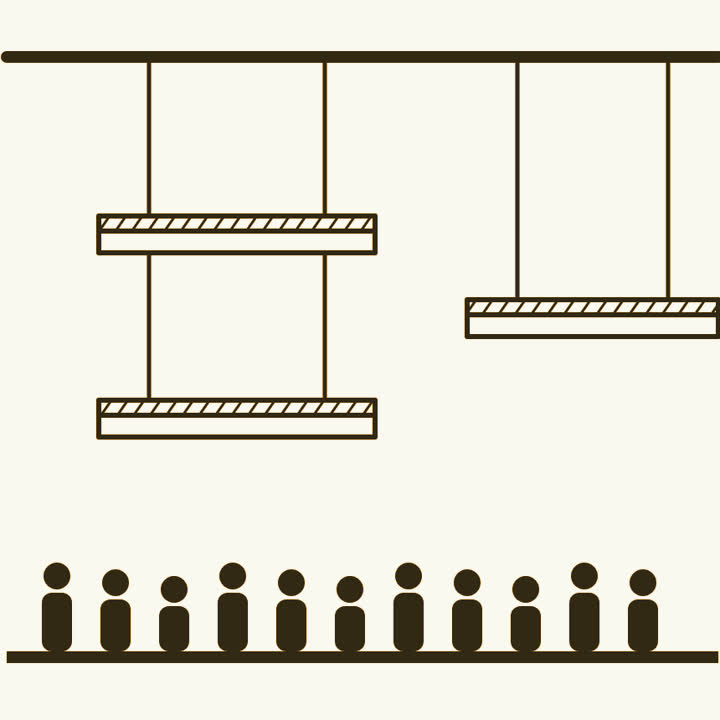
In July 1981, crowds gathered for a tea dance at a hotel in Kansas City.
The Hyatt Regency had a tall open atrium, with walkways crossing high above the lobby. The walkways hung from the ceiling on steel rods. Well over a thousand people were there, and some watched from the walkways.
Just after seven in the evening, two of the walkways collapsed.
The fourth floor walkway fell onto the second floor walkway directly beneath it, and both fell onto the crowded lobby. One hundred and fourteen people died, and more than two hundred were injured. A third walkway, set off to one side, did not fall.
The original design hung both stacked walkways from long, continuous rods.
Each rod ran down from the ceiling, through the beams of the upper walkway, and on to the lower one. The nut under the upper walkway had to hold up only that walkway. The rod itself carried the weight of the lower walkway past it.
During construction, the design was changed to use two sets of shorter rods.
The steel fabricator proposed the change, and it went ahead. One set of rods hung the upper walkway from the ceiling. A second set hung the lower walkway from the upper one. That roughly doubled the load on the connections holding up the upper walkway.
Investigators found that the connections could barely carry the walkways’ own weight.
The National Bureau of Standards blamed connections between the beams and the hanger rods that could not carry enough load. Even the original design fell short of the building code, but the change made the connection far weaker. The failure began where a rod and its nut pulled through a beam of the upper walkway.
No one was charged with a crime, but the engineers lost their licences.
In 1985, a judge found the engineers responsible for the design guilty of gross negligence and misconduct. In 1986, Missouri revoked their engineering licences. The case made it clear that engineers stay responsible for checking changes to their designs.
So when a small change is proposed, ask where the weight goes now.
Swapping one rod for two looked like a detail on a drawing. But it changed the path the weight took through the structure. A change to a design is a new design, and it deserves the same checking as the first.
Sources
- Walkway collapse, Kansas City, Missouri, 1981, National Institute of Standards and Technology. A summary of the federal investigation.
- Investigation of the Kansas City Hyatt Regency walkways collapse, National Bureau of Standards, 1982. The full technical report.
- Hyatt Regency walkway collapse, Wikipedia. An overview with diagrams of the rod change.
Nearby ideas
- The bridge that twisted itself apart. How a steady wind twisted a brand new bridge until it fell.
- The rubber that could not spring back. How engineers warned that cold would stop Challenger's seals working, and were overruled.
- Cheap steel and a costly mistake. How cheap steel failed for everyone except its inventor, and why.
- The cracks nobody could see. How investigators found the hidden cracks that brought down the first jet airliner.
- The ships that cracked in the cold. How welded wartime ships cracked in the cold, and the scientist who worked out why.