Cobra Effect · Thinking and evidence
Anchoring
The first number you hear bends every estimate that follows.
6 cards, read aloud in 2:37, with a test and sources.
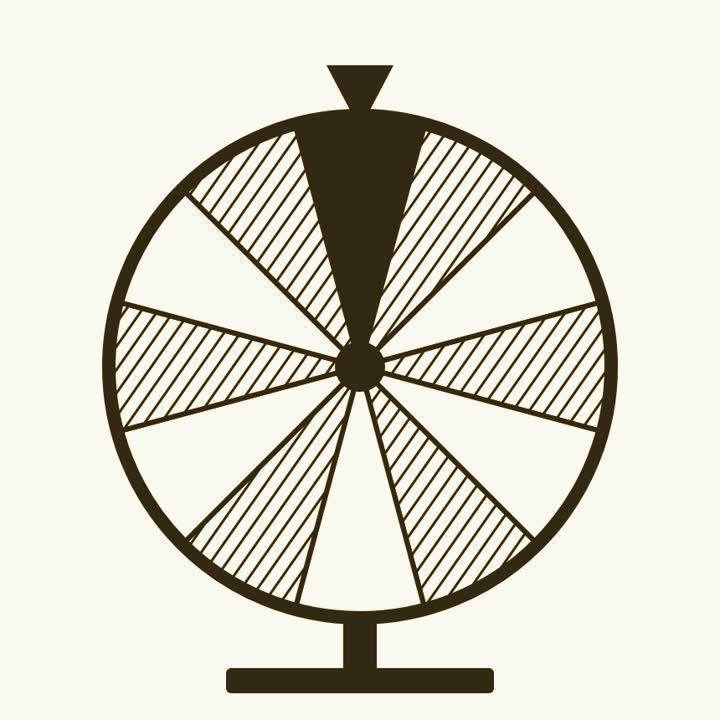
A wheel of fortune stops on 65. Then they ask you about Africa.
Amos Tversky and Daniel Kahneman, 1974. They spin a wheel in front of their subjects. It is rigged to stop on 10 or 65. Then they ask what percentage of African countries are members of the United Nations. The wheel has nothing to do with the answer. Everyone knows that.
The wheel moved the answers anyway.
People who saw 10 typically guessed 25%. People who saw 65 typically guessed 45%. A random number they had just watched being random shifted their estimates by twenty points. Some were paid for accuracy. It made no difference.
That is anchoring.
The first number you meet becomes the starting point, and you adjust from it. You adjust too little. It works even when the number is obviously irrelevant, and even when you know the trick. The anchor does not need to be believed. It only needs to be seen.
Same paper, another trick.
Students were given five seconds to estimate 8 times 7 times 6, and so on down to 1. Others got the same numbers in the other order, starting with 1 times 2 times 3. The first group’s typical answer was 2,250. The second group’s was 512. The real answer is 40,320. The first numbers you see set the scale.
It runs the world’s negotiations.
The first offer in a haggle sets the range. In a 1987 study, estate agents shown a higher asking price valued the same house higher, and were sure the price had not influenced them. In a German study, judges who rolled higher on a pair of dice handed down longer sentences. Menus, salary talks, charity appeals. Whoever names the first number owns the middle.
You cannot switch it off. You can choose the anchor.
Before you hear anyone else’s number, write down your own. When a number arrives first, ask what the range would look like if it had never been said. And when you are the one selling, go first. Somebody is going to drop the anchor. Make sure it’s yours.
Sources
- Judgment under Uncertainty: Heuristics and Biases, Amos Tversky and Daniel Kahneman, 1974. The paper with the wheel and the multiplication trick, in Science, volume 185. Short and readable. Search the title with the year for a free copy.
- Thinking, Fast and Slow, Daniel Kahneman, 2011. Chapter eleven is called Anchors. It has the wheel, the estate agents, the judges and the dice, told by one of the people who found it.
- Anchoring effect, Wikipedia. The studies since 1974, the arguments about why it happens, and the long list of places it has been found.
Nearby ideas
- Base rate neglect. A good test for a rare thing still gives mostly false alarms.
- The sunk cost fallacy. Money already spent is gone, so it should not steer the next choice.
- Regression to the mean. Extreme results drift back towards normal, whatever you do.
- The availability heuristic. Vivid stories make rare dangers feel common.
- The narrative fallacy. We invent causes for events because stories feel like explanations.
- Hindsight bias. Once you know the ending, it always looks obvious.
- Outcome bias. Judge a decision by what was known, not by how the dice fell.
- The framing effect. The same facts, worded differently, lead to different choices.