Cobra Effect · Evidence in medicine
The first public operation under ether
How a public test in Boston made painless surgery believable.
7 cards, read aloud in 2:53, with a test and sources.
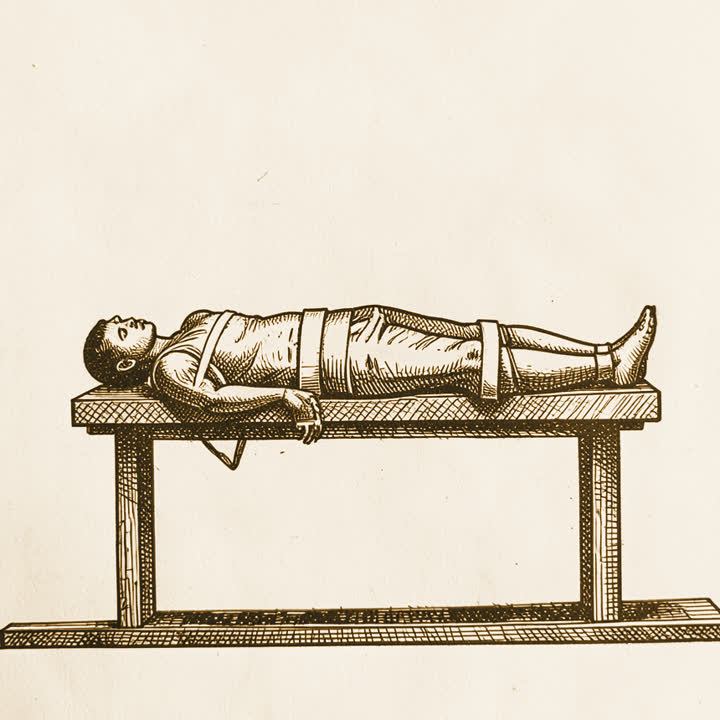
Before the 1840s, surgery was done while the patient was wide awake.
Patients were held or strapped down, and surgeons worked as fast as they could. Many people put off operations for as long as they could bear. Alcohol and opium dulled the pain a little, but not enough.
In 1845, a dentist tried to show that a gas could take the pain away.
Horace Wells, of Hartford in Connecticut, had used nitrous oxide while pulling teeth. He gave a demonstration before students and doctors in Boston. But the patient cried out, perhaps because the gas was taken away too soon. Some in the audience called it a humbug.
In 1846, another Boston dentist tried again, this time with ether.
William Morton had once worked with Wells. He tested ether on himself and on dental patients. He disguised it with colouring and called it Letheon, hoping to patent it. Then he persuaded surgeons at Massachusetts General Hospital to let him try it in public.
In October 1846, a patient lay down in front of a watching crowd.
Edward Gilbert Abbott needed a growth removed from his neck. Morton held a glass inhaler of ether to his face until he slept. The surgeon John Collins Warren began to cut. Afterwards, Abbott said he had felt no pain.
Warren turned to the crowd and said it plainly: gentlemen, this is no humbug.
News of the operation spread fast, and within months ether was used for surgery in Europe too. In fact, a Georgia doctor named Crawford Long had used ether in an operation in 1842. But he did not publish his results until years later, so few knew. What made Boston different was that the test was done in public, before experts.
Then came a bitter fight over who deserved the credit.
Letheon was soon recognised as ordinary ether. The chemist Charles Jackson claimed he had told Morton to use it. Wells, Morton and Jackson spent years arguing their claims. The quarrel brought all three of them more grief than reward.
So when you have found something that works, ask who needs to see it for themselves.
Long used ether first, but his result stayed private for years. Wells’s demonstration was public, but it failed. Morton’s succeeded in front of the people who could spread it. A discovery changes practice when it is shown openly, to people able to check it.
Sources
- The Ether Dome, Massachusetts General Hospital. The operating theatre where ether was first demonstrated in public.
- Ether Day, 16 October 1846: the Conquest of Pain, Massachusetts Historical Society. The operation, the people in the room, and what followed.
- Horace Wells, Linda Hall Library. The dentist whose earlier demonstration with nitrous oxide failed.
Nearby ideas
- The reviewer who asked for more. How one reviewer's demand for better evidence kept thalidomide off American shelves.
- Germs do not come from nowhere. How a swan-neck flask and a country doctor proved that germs cause disease.
- The cells that would not stop growing. How one woman's cells changed medicine, and the question of consent they raised.
- Twelve sailors and a fair test. How a fair test at sea pointed to a remedy for scurvy, decades before the Navy acted.
- The doctors who tracked smoking. How two doctors showed smoking causes lung cancer without a single experiment.
- Nearly two million children and a fair test. How a vast, blinded trial showed the polio vaccine worked, and why checking went on.