Cobra Effect · Body and medicine
The extract that saved a boy
How a quarrelling team in Toronto turned a deadly disease into one people could live with.
7 cards, read aloud in 3:09, with a test and sources.
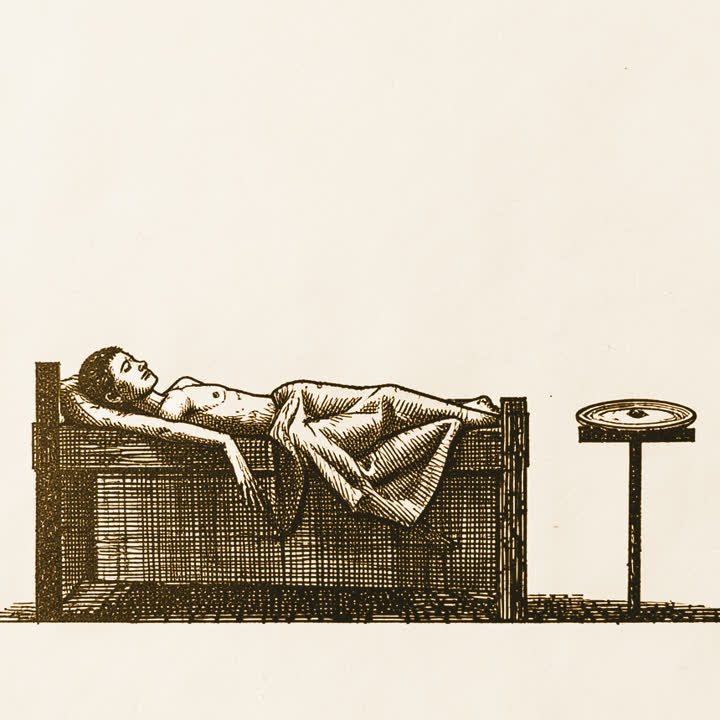
Before 1922, a child diagnosed with type 1 diabetes rarely lived long.
In type 1 diabetes, the body cannot make insulin, a hormone that lets cells take up sugar from the blood. Without insulin, sugar builds up in the blood while the body starves. Doctors could only put patients on strict starvation diets, which bought a little time. Scientists suspected the pancreas made the missing substance, but no one had managed to extract it.
In the summer of 1921, Frederick Banting and Charles Best set out to extract it in Toronto.
Banting was a young surgeon with an idea, and Best was a student who worked with him. They worked in the laboratory of John Macleod, at the University of Toronto. They gave dogs diabetes by removing the pancreas, then injected them with an extract made from pancreas. The extract brought the dogs’ blood sugar down.
In January 1922, a fourteen-year-old boy became the first person given the extract.
Leonard Thompson was gravely ill with diabetes in Toronto General Hospital. His first injection did not work well enough. The team needed a cleaner, purer extract. A biochemist called James Collip was working on one.
James Collip purified the extract using alcohol.
Collip had joined the work in December 1921. By carefully adjusting how much alcohol he used, he separated the active substance from the rest. Later in January 1922, Leonard was given Collip’s purified extract. This time his blood sugar fell, and he began to recover.
Word spread fast, and insulin was soon being made in large amounts.
Other patients close to death were treated, and many of them recovered. The University of Toronto worked with drug companies to make insulin in quantity. Within a few years, insulin was saving lives around the world. Type 1 diabetes had become a condition people could live with.
In 1923, Banting and Macleod were awarded the Nobel Prize.
Banting was angry that Best had been left out, and shared his prize money with him. Macleod shared his with Collip. The discoverers had sold their patent to the University of Toronto for a dollar each. Today, millions of people rely on insulin every day.
So when a breakthrough carries one famous name, ask who else it needed.
Banting had the idea, Best did the experiments with him, Macleod gave them a laboratory, and Collip made the extract pure. The four argued bitterly about who deserved the credit. Yet none of them could have done it alone. A boy lived because a team, however quarrelsome, finished the job.
Sources
- The miracle discovery that reversed the diabetes death sentence, NobelPrize.org. The story of insulin, from Banting’s idea to its first patients.
- Leonard Thompson, University of Toronto, Thomas Fisher Rare Book Library. The first patient, his two injections and his recovery.
- The discovery of insulin: a story of monstrous egos and toxic rivalries, The Conversation. The bitter arguments between Banting, Best, Macleod and Collip.
Nearby ideas
- Penicillin needed more than luck. How a mouldy dish became a medicine only after a team made it work.
- The blood goes round. How a simple sum showed that the same blood goes round and round the body.
- Germs do not come from nowhere. How a swan-neck flask and a country doctor proved that germs cause disease.
- The pump that spread cholera. How a map of deaths around one pump showed that cholera spreads through water.
- From a milkmaid’s hand to the end of smallpox. How a country saying about milkmaids led to the first vaccine and the end of smallpox.
- The doctor who drank the germ. How a doctor drank a germ to prove that bacteria, not stress, cause most ulcers.