Cobra Effect · Body and medicine
Penicillin needed more than luck
How a mouldy dish became a medicine only after a team made it work.
7 cards, read aloud in 3:10, with a test and sources.
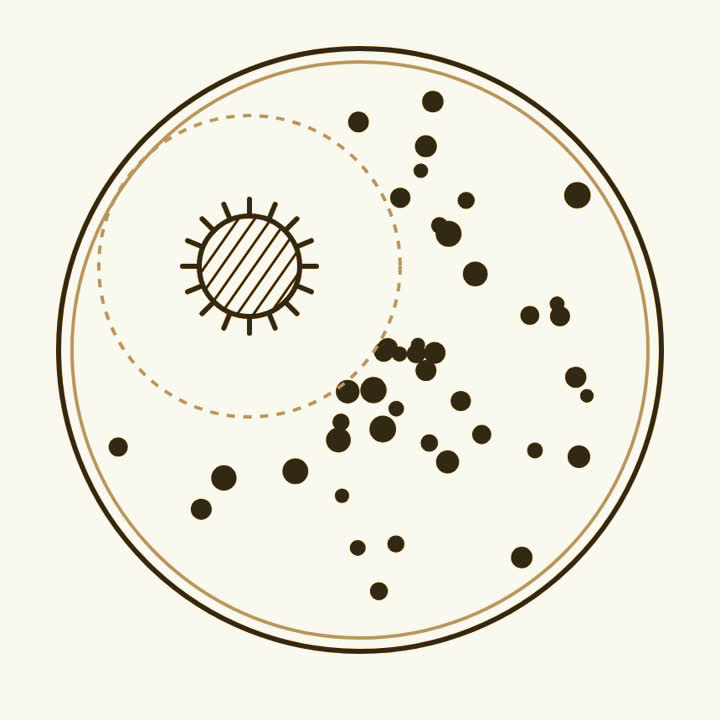
In September 1928, Alexander Fleming came back from holiday to find mould on one of his dishes.
Fleming worked at St Mary’s Hospital in London, growing bacteria called staphylococci on dishes of jelly. A mould had landed on one of the dishes while he was away. Around the mould was a clear ring, where the bacteria had died. Something coming from the mould was killing them.
Fleming named the substance penicillin, after the mould.
The mould was a kind of Penicillium. In 1929 he described penicillin in a medical journal. But it was hard to extract, unstable, and made only in tiny amounts. Fleming could not turn it into a usable medicine, and for about a decade little came of it.
At Oxford, Howard Florey and Ernst Chain took up the forgotten mould.
In 1939 their team began trying to purify penicillin and test it properly. The work was slow: a great deal of mould broth gave only a tiny amount of the drug. They grew the mould in whatever containers they could find. By May 1940, they had enough to test it on animals.
Mice given a deadly infection survived when they were also given penicillin.
The team infected eight mice with bacteria, and gave penicillin to four of them. Hours later, the four treated mice were alive. The four untreated mice were dead. In August 1940 the team reported the results in the medical journal The Lancet. Now they needed to know whether it would work in people.
In February 1941, a police officer became the first person the Oxford team treated.
Albert Alexander, aged forty three, had a severe infection that was spreading. Within a day of his first injections, he began to improve. There was so little penicillin that the team recovered it from his urine to use again. But the supply ran out before he was cured, and he died in March 1941.
Making penicillin in huge amounts turned it into a medicine for millions.
During the Second World War, companies, especially in the United States, learned to grow the mould in giant tanks. Production rose from a trickle to vast quantities. It saved great numbers of wounded soldiers and, after the war, ordinary patients. In 1945 Fleming, Florey and Chain shared the Nobel Prize.
So when a discovery is told as a lucky accident, ask who did the rest of the work.
Fleming’s mouldy dish was a real stroke of luck. But luck alone did not make a medicine. It took a team at Oxford to purify it and prove that it worked. Then it took engineers and factories to make enough of it. Most great discoveries are relays, not single moments.
Sources
- How was penicillin developed?, Science Museum. From Fleming’s dish to the Oxford team and mass production.
- Guns, not roses: the true story of penicillin’s first patient, The Conversation. What really happened to Albert Alexander, and why the popular version is wrong.
- The penicillin myth, Asimov Press. Why the lucky accident story leaves out most of the work.
Nearby ideas
- From a milkmaid’s hand to the end of smallpox. How a country saying about milkmaids led to the first vaccine and the end of smallpox.
- Evolution in a flask. How twelve flasks and a giant dish let scientists watch bacteria evolve.
- The doctor who drank the germ. How a doctor drank a germ to prove that bacteria, not stress, cause most ulcers.
- The extract that saved a boy. How a quarrelling team in Toronto turned a deadly disease into one people could live with.
- Germs do not come from nowhere. How a swan-neck flask and a country doctor proved that germs cause disease.
- The pump that spread cholera. How a map of deaths around one pump showed that cholera spreads through water.
- The blood goes round. How a simple sum showed that the same blood goes round and round the body.