Cobra Effect · Body and medicine
From a milkmaid’s hand to the end of smallpox
How a country saying about milkmaids led to the first vaccine and the end of smallpox.
7 cards, read aloud in 3:16, with a test and sources.
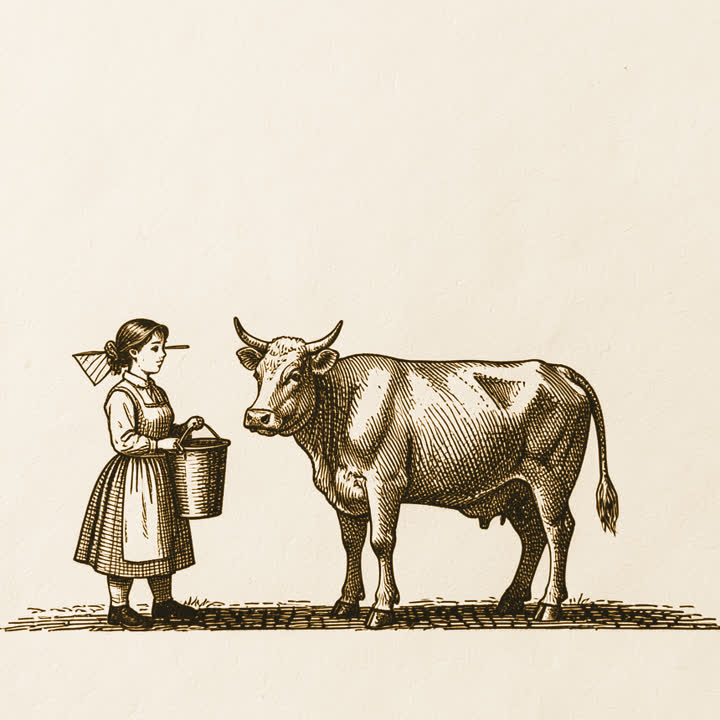
People in the English countryside said milkmaids did not get smallpox.
Smallpox was one of the deadliest diseases in history. In the twentieth century alone it killed about three hundred million people. People already protected themselves by variolation, deliberately giving a mild dose of smallpox, which was risky. But it was said that people who had caught cowpox from cows did not catch smallpox. Edward Jenner, a country doctor in Gloucestershire, took the saying seriously.
Sarah Nelmes, a milkmaid, had caught cowpox from a cow called Blossom.
Cowpox is a mild disease, related to smallpox, that causes sores on cows and on the hands of people who milk them. In May 1796, Sarah Nelmes had fresh cowpox sores on her hand. Jenner took fluid from one of the sores. He wanted to test whether cowpox really protected against smallpox.
In May 1796, Jenner scratched cowpox into the arm of an eight-year-old boy.
The boy was James Phipps. Jenner put fluid from Sarah Nelmes’s sore into two small cuts on his arm. Cowpox was known to be a mild illness. Then came the part that would never be allowed today.
Weeks later, Jenner exposed the boy to smallpox itself, and he did not fall ill.
At the start of July, Jenner put matter from a smallpox sore into James’s arm. James did not develop smallpox. Deliberately exposing a child to a deadly disease would be unthinkable today. But it pointed to a far safer way of protecting people than variolation.
Jenner named the method after the cow.
In 1798 he published his results, including the case of James Phipps, at his own expense. He called cowpox variolae vaccinae, from vacca, the Latin word for cow. From that came the words vaccine and vaccination. In 1881 Louis Pasteur proposed using those words for all such protection, in Jenner’s honour.
In the 1960s, the world set out to wipe smallpox out.
The World Health Organization led a global programme to end the disease. Country by country, smallpox disappeared. The last natural case was Ali Maow Maalin, a hospital cook in Somalia, in October 1977. He recovered. He later spent years working to wipe out polio.
So when an old country saying seems too simple, ask whether it could be tested.
In May 1980, the World Health Organization declared smallpox eradicated. It was the first human disease ever wiped out. It began with a milkmaid’s hand, a boy’s arm, and a doctor who took a rural saying seriously enough to test it. Folk wisdom is not always right. Sometimes it is worth checking.
Sources
- History of smallpox vaccination, World Health Organization. From variolation and Jenner to the global eradication programme.
- Edward Jenner’s discovery of vaccination: impact and legacy, PMC review, 2024. Jenner’s experiment, his book of 1798, and what came after.
- Last person to get smallpox dedicated his life to ending polio, NPR, 2013. The story of Ali Maow Maalin, the last natural case of smallpox.
Nearby ideas
- The blood goes round. How a simple sum showed that the same blood goes round and round the body.
- Penicillin needed more than luck. How a mouldy dish became a medicine only after a team made it work.
- The doctor who drank the germ. How a doctor drank a germ to prove that bacteria, not stress, cause most ulcers.
- The extract that saved a boy. How a quarrelling team in Toronto turned a deadly disease into one people could live with.
- Germs do not come from nowhere. How a swan-neck flask and a country doctor proved that germs cause disease.
- The pump that spread cholera. How a map of deaths around one pump showed that cholera spreads through water.