Cobra Effect · Chemistry
The ozone hole and the treaty that worked
How a warning about spray-can chemicals led to a treaty every country signed.
7 cards, read aloud in 3:52, with a test and sources.
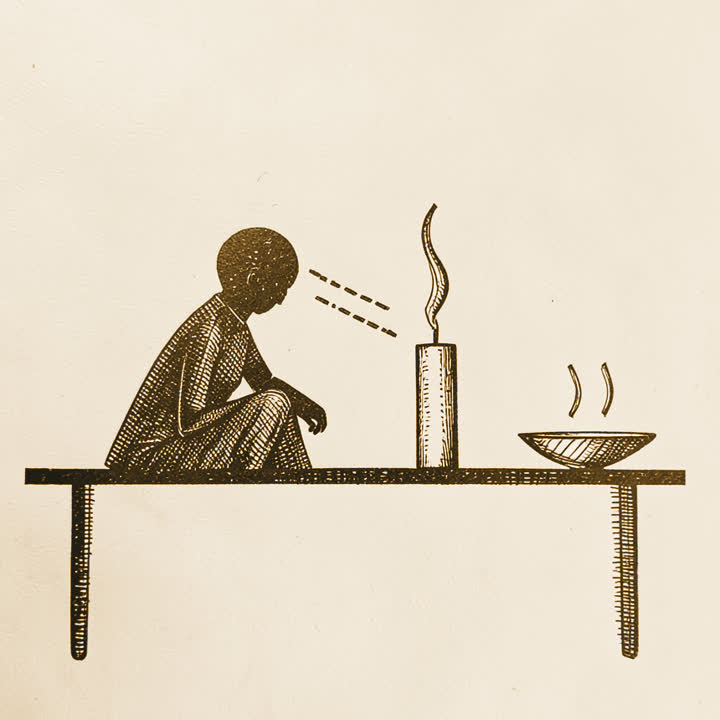
In 1930 Thomas Midgley showed off a safe new gas for refrigerators.
Early refrigerators used gases that were poisonous or could catch fire. Midgley’s team made a chlorofluorocarbon, or CFC, that was neither. At a meeting of chemists, he breathed in the vapour and blew out a candle with it. CFCs soon filled refrigerators and air conditioners, and later spray cans too.
CFCs were so stable that almost nothing in the lower air could break them down.
They hardly react with anything, and rain does not wash them out. Over years they drift up into the stratosphere, the high layer of air that holds most of the ozone. That ozone absorbs much of the Sun’s harmful ultraviolet light before it reaches the ground. Up there, strong ultraviolet light finally breaks CFC molecules apart, freeing their chlorine.
In 1974 Mario Molina and Sherwood Rowland warned that the chlorine would destroy ozone.
They worked it out at the University of California, Irvine, and published it in the journal Nature. A chlorine atom breaks up an ozone molecule, is set free again, and goes on to break up another. Each chlorine atom can destroy many thousands of ozone molecules before it is removed. CFC makers disputed the warning, and nobody had yet measured any loss of ozone.
In 1985 British scientists reported a huge seasonal loss of ozone over Antarctica.
Joe Farman, Brian Gardiner and Jonathan Shanklin of the British Antarctic Survey used instruments on the ground to measure the ozone above them. By 1984, the ozone above Halley station each October was only about two thirds of what it had been in earlier decades. Models had predicted slow, gradual losses, not anything this large. Every southern spring a vast region of thin ozone opened up. It became known as the ozone hole.
Clouds high over Antarctica turned out to speed up the destruction.
In the dark polar winter, the stratosphere gets cold enough for thin clouds to form. On the cloud particles, chlorine is turned from harmless forms into forms that attack ozone. When sunlight returns in spring, that chlorine destroys ozone very quickly. In 1987, a high-flying research plane flew south into the hole and found the most chlorine where ozone was lowest.
In 1987 nations agreed the Montreal Protocol to phase out CFCs.
The treaty was strengthened several times as the science grew clearer. In 2009 it became the first environmental treaty to be ratified by every country in the world. In 1995 Paul Crutzen, Mario Molina and Sherwood Rowland shared the Nobel Prize in Chemistry for their work on ozone. The amount of chlorine in the stratosphere peaked in the late 1990s, and has been slowly falling since.
So when a warning comes before the damage shows, ask what waiting would cost.
Molina and Rowland warned of ozone loss more than ten years before the hole was found. CFCs last for decades in the air, so the damage goes on long after emissions fall. Scientists expect the ozone over Antarctica to return to its level of 1980 around the year 2066, if the treaty holds. The hole still opens every spring, but it is slowly mending.
Sources
- The ozone hole discovery, British Antarctic Survey. How measurements at Halley revealed the hole, told by the survey itself.
- Ozone depletion: uncovering the hidden hazard of hairspray, Understanding Science, UC Berkeley. The science step by step, from Molina and Rowland to the clouds over Antarctica.
- Ozone layer recovery is on track, UN Environment Programme. The 2023 assessment, and when each region should recover.
Nearby ideas
- Fertiliser made from thin air. How chemists learned to pull fertiliser out of the air, and what else it made.
- There is light on both sides of the rainbow. How thermometers, silver salts and a glowing screen found light we cannot see.
- Weighing everything changed chemistry. How weighing everything before and after overturned an old idea about burning.
- The table that predicted missing elements. How a table of the elements left gaps, and the gaps were filled as predicted.
- The ore that gave off too many rays. How rays that were too strong to explain led to two new elements.
- The bounce that revealed the nucleus. How a few particles bouncing back off gold foil revealed the nucleus.