Cobra Effect · Chemistry
The bounce that revealed the nucleus
How a few particles bouncing back off gold foil revealed the nucleus.
7 cards, read aloud in 3:35, with a test and sources.
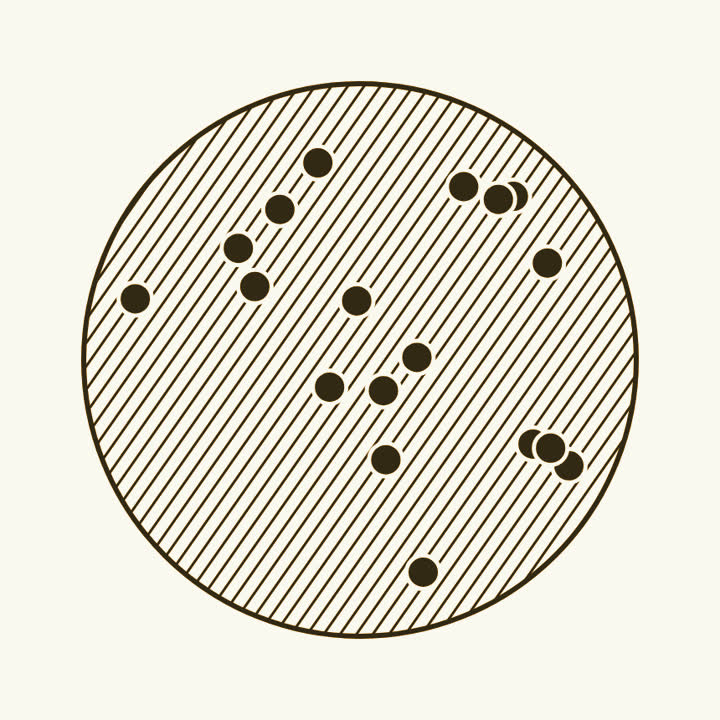
In 1904 J. J. Thomson pictured the atom as a ball of spread-out positive charge.
Thomson had discovered the electron, a tiny particle with a negative charge, in 1897. Atoms have no overall charge, so the positive charge had to be somewhere. In his model it was spread through the whole atom, with electrons dotted in it like plums in a pudding. It became known as the plum pudding model. Nobody had yet found a way to look inside an atom.
In Manchester, Ernest Rutherford’s team fired alpha particles at thin gold foil.
Rutherford was a physicist from New Zealand, born in 1871 at Brightwater, near Nelson. Alpha particles are fast, heavy, positively charged particles given off by radioactive substances. Hans Geiger and a young student, Ernest Marsden, aimed a narrow beam of them at a very thin sheet of gold. Each particle that struck a special screen made a tiny flash, and they counted the flashes by eye through a microscope, in a darkened room.
Nearly all the particles went straight through the gold, as expected.
In a plum pudding atom, the positive charge is spread thin. A fast, heavy alpha particle should punch through it, barely nudged. That is what nearly all of them did. Some were turned aside by small angles, which also fitted the model.
In 1909 Geiger and Marsden found that a few particles bounced back.
Rutherford had suggested that Marsden look for particles scattered through large angles. About one in eight thousand came back off the foil, toward the side it had come from. Nothing in a plum pudding atom was strong enough to turn a fast alpha particle around. Something inside the gold was pushing back very hard.
Rutherford compared it to a cannon shell bouncing back off tissue paper.
He later described it as the most astonishing thing that had ever happened to him. The answer had to explain both results at once. Most particles passed through as if almost nothing were there, yet a very few were turned right around. Rutherford spent the next two years working out what kind of atom could do both.
In 1911 Rutherford proposed that an atom’s positive charge sits in a tiny centre.
Almost all of the atom’s mass is packed into that centre, which came to be called the nucleus. The electrons lie somewhere in the vast space around it. An alpha particle passing close to a nucleus is pushed hard away, and one heading almost straight at it is sent back. His calculation predicted how many particles should scatter at each angle, and Geiger and Marsden’s later measurements agreed.
So when a result seems impossible, ask what would have to be true to explain it.
Rutherford did not dismiss the rare particles that bounced back. Taking them seriously overturned the plum pudding picture of the atom. A nucleus is tens of thousands of times smaller across than its atom, so an atom is almost entirely empty space. Rutherford had already won the Nobel Prize in Chemistry in 1908. His most famous discovery came afterwards.
Sources
- Alpha particles and the atom, American Institute of Physics. Rutherford’s Manchester years, and how the nucleus was found.
- May 1911: Rutherford and the discovery of the atomic nucleus, APS News. A short history of the experiment and the paper that followed.
- Rutherford wins Nobel Prize in Chemistry, NZ History. The New Zealander behind the nucleus, and his prize of 1908.
Nearby ideas
- The ore that gave off too many rays. How rays that were too strong to explain led to two new elements.
- Atomic spectra and energy levels. Why each element glows in its own few colours, like a fingerprint.
- Fertiliser made from thin air. How chemists learned to pull fertiliser out of the air, and what else it made.
- The ozone hole and the treaty that worked. How a warning about spray-can chemicals led to a treaty every country signed.
- Weighing everything changed chemistry. How weighing everything before and after overturned an old idea about burning.
- The table that predicted missing elements. How a table of the elements left gaps, and the gaps were filled as predicted.