Cobra Effect · Light and electricity
There is light on both sides of the rainbow
How thermometers, silver salts and a glowing screen found light we cannot see.
7 cards, read aloud in 3:33, with a test and sources.
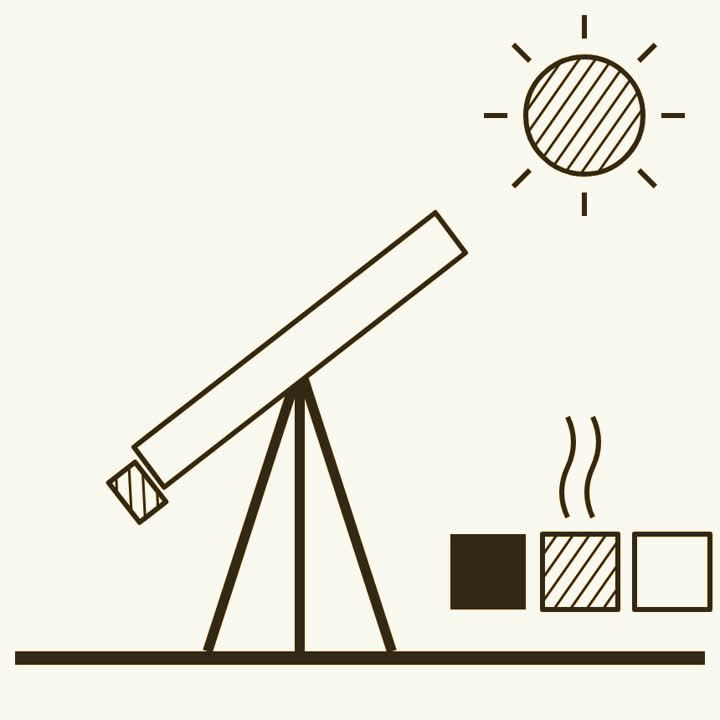
In 1800 the astronomer William Herschel noticed that coloured glass let through different amounts of heat.
He was trying out coloured filters, to look at the Sun safely through his telescope. Some let through little light but a lot of heat. Others let through plenty of light and little heat. He wondered whether the colours of sunlight carried different amounts of heat. So he spread sunlight with a prism and put thermometers in the colours.
The thermometers got warmer towards red, and warmer still just past it, in the dark.
He used thermometers with blackened bulbs, and kept others out of the light to compare. Violet warmed them least, and each colour towards red warmed them more. When he moved a thermometer beyond the red end, where there was no light to see, it read hotter still. He concluded that the Sun gives out invisible rays that the prism bends even less than red. We call them infrared.
A year later, Johann Ritter looked past the other end.
Chemists already knew that sunlight turns silver chloride dark, and that violet light does it fastest. In 1801 Ritter spread sunlight with a prism over paper coated with silver chloride. The paper darkened most strongly just beyond the violet, where he could see no light at all. There were invisible rays on that side too. We call them ultraviolet.
In 1895 Wilhelm Roentgen saw a screen glow on the far side of a dark room.
He was sending electricity through a glass tube, wrapped in black card, in a darkened room. A paper screen coated with a glowing chemical lit up, even about two metres from the tube. Something invisible was coming out of the tube, straight through the card. Not knowing what the rays were, he called them X-rays.
Weeks later he made a picture of the bones in his wife’s hand.
Just before Christmas, his wife Bertha held her hand on a photographic plate in the path of the rays. Flesh let the rays through more easily than bone, so the picture showed her bones, and the ring on her finger. Within a week, Roentgen had sent off his first paper on the new rays. He took out no patent, and within a year doctors were using X-rays to find bullets in wounded soldiers.
Light beyond the rainbow is all around us, and some animals can sense it.
Bees see ultraviolet, and many flowers have ultraviolet patterns that guide them to the nectar. Pit vipers have heat sensing pits on their faces that pick up the infrared given off by warm prey, even in the dark. The ultraviolet in sunlight is what burns skin. And a television remote usually talks to the set with a beam of infrared.
So when you think you are seeing everything, ask what lies beyond the edges of your senses.
Herschel, Ritter and Roentgen each found something by looking where there seemed to be nothing. Later work showed that infrared, ultraviolet and X-rays are the same kind of thing as light, differing only in wavelength. Visible light is a narrow band in a far wider range, from radio waves to gamma rays. The rainbow is only the part our eyes happen to catch.
Sources
- Investigation of the powers of the prismatic colours to heat and illuminate objects, William Herschel, Philosophical Transactions, 1800. Herschel’s own account of the thermometers in the spectrum, and the heat he found beyond the red.
- Herschel and the puzzle of infrared, American Scientist. How Herschel found heat without light, and why it took decades to accept that infrared is light.
- Wilhelm Conrad Roentgen, biographical, NobelPrize.org. The glowing screen, the picture of Bertha’s hand, and the first Nobel Prize in Physics.
Nearby ideas
- White light is every colour at once. How a second prism showed the colours were in sunlight all along.
- Atomic spectra and energy levels. Why each element glows in its own few colours, like a fingerprint.
- Light takes time to arrive. How a moon of Jupiter and a spinning wheel showed that light takes time to arrive.
- Lightning is a giant spark. How a thread, a jar and an iron rod showed that lightning is electricity.
- A frog’s twitch led to the first battery. How an argument over twitching frogs’ legs gave the world its first battery.
- A moving magnet makes electricity. How a swinging compass needle led, in eleven years, to the first generator.
- Light is a wave of electricity and magnetism. How equations predicted invisible waves, and sparks across a room proved them real.
- Why the sky is blue. How a hazy glass tube and a calculation explained the colour of the sky.