Cobra Effect · Quantum mechanics
Atomic spectra and energy levels
Why each element glows in its own few colours, like a fingerprint.
7 cards, read aloud in 3:07, with a test and sources.
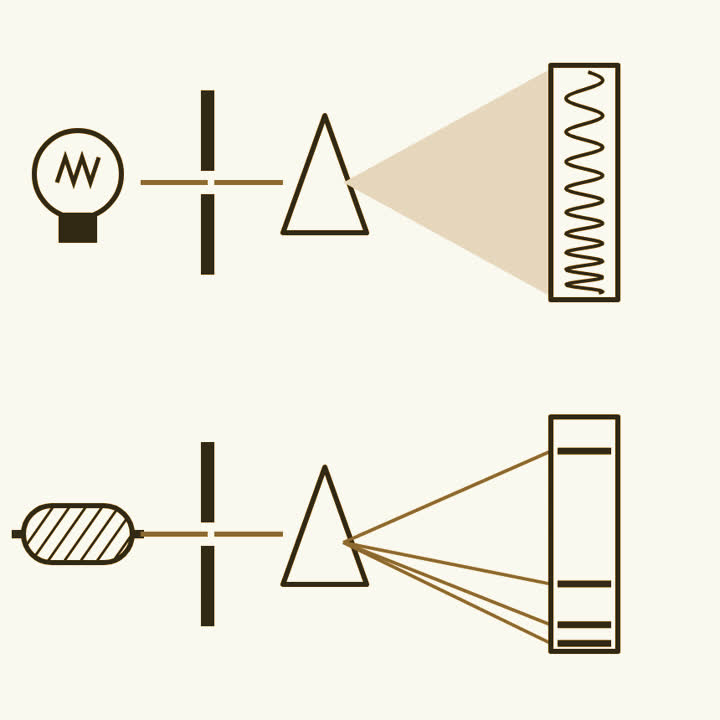
Make a gas glow and pass its light through a prism. You do not get a rainbow.
A glowing solid, like a lamp filament, spreads into a smooth band of every colour. A thin glowing gas gives something else. A few sharp lines of colour, with darkness in between. Hydrogen gives four you can see. Red, blue green, and two shades of violet.
Every element has its own lines, and they never move.
In 1859 Gustav Kirchhoff and Robert Bunsen held one substance after another in a clean flame. Sodium always gave the same pair of yellow lines, very close together. Change the flame, change the amount, and the lines stayed exactly where they were. The lines were a fingerprint.
In 1868 the Sun showed a line that matched nothing on Earth.
Astronomers studying the light from the edge of the Sun found a bright yellow line. No known element made it. Norman Lockyer decided it came from a new one, and it was named helium, after the Greek word for the Sun. Helium was not found on Earth until 1895.
A schoolteacher found the pattern in hydrogen’s lines, without knowing why.
In 1885 Johann Balmer, who taught at a girls’ school in Basel, studied the four lines of hydrogen. He found one simple formula that gave all four positions. It also said more lines should follow, closer and closer together, past the violet end. They did. Nobody could say why.
By the rules of the day, atoms should not have lasted a moment.
In 1911 Ernest Rutherford showed that an atom is a tiny heavy nucleus with electrons around it. But an electron going round and round should give off light all the time. Losing energy, it should spiral into the nucleus in a tiny fraction of a second. Atoms last, and they shine in lines.
In 1913 Niels Bohr said an electron can only sit on certain energy levels.
Between those levels, there is nowhere to be. When an electron drops to a lower level, the atom gives off one packet of light. The size of the drop sets the colour of the packet. Only certain drops are possible, so only certain colours come out. His sums gave Balmer’s formula.
So when you see a coloured light, ask what drop made it.
Bohr pictured electrons circling like tiny planets, and that picture was later dropped. Quantum mechanics replaced the orbits with spread out waves around the nucleus. The fixed levels survived, and so did the lines. A neon sign, a sodium street lamp, the light of a star. Each colour is an atom dropping one exact step.
Sources
- The structure of the atom, Niels Bohr, Nobel lecture, 1922. Bohr’s own account of how fixed energy levels explain the lines of hydrogen, and of the problems his model still left open.
- Hydrogen spectral series, Wikipedia. The Balmer and Lyman series, the formula behind them, and how each series comes from drops to one particular level.
- Bohr model, Wikipedia. Where the model came from, what it got right about energy levels, and why its neat orbits were replaced by quantum mechanics.
Nearby ideas
- The photoelectric effect. The experiment that showed light arrives in packets, not only as waves.
- Superposition and the double slit. One electron at a time, and still a pattern only waves should make.
- The uncertainty principle. Why pinning down where a particle is spreads out where it is going.
- Spin, and the magnet that split a beam. The magnet experiment that showed atoms answer in just two ways.
- Quantum tunnelling. How particles slip through walls they lack the energy to climb.
- The exclusion principle. Why no two electrons can share a place, and why that makes matter solid.
- Entanglement and Bell’s test. Why two distant particles share results no advance plan can explain.
- Decoherence. Why big things never show two states at once.