Cobra Effect · Earth
The clay layer that pointed to an asteroid
How a thin layer of clay led to an asteroid, and a crater in Mexico.
7 cards, read aloud in 3:30, with a test and sources.
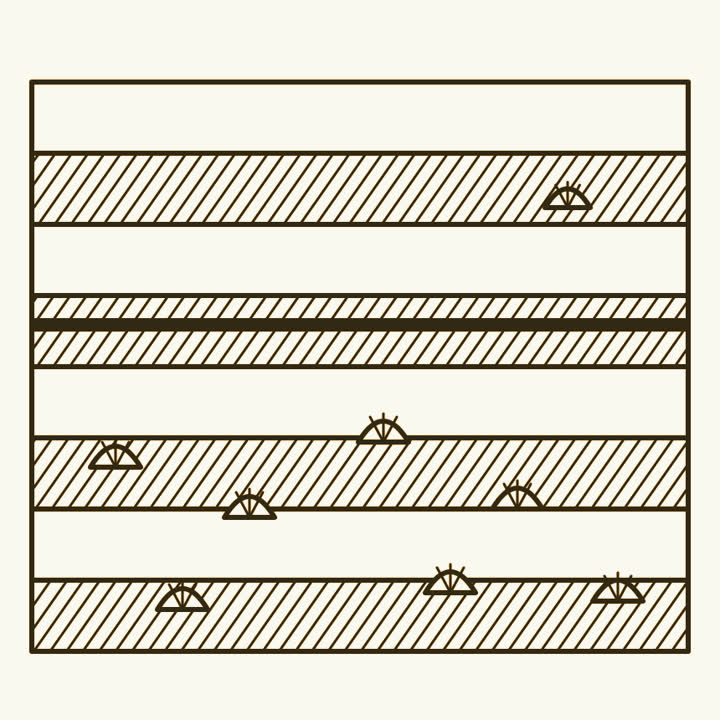
About sixty six million years ago, the dinosaurs other than birds died out, along with a great many other species.
The extinction marks the end of the Cretaceous period. In rocks around the world, the fossils change sharply at a thin boundary layer. For more than a century, the cause was a mystery. Ideas ranged from slowly changing climates to vast volcanic eruptions.
Near Gubbio in Italy, the geologist Walter Alvarez studied a thin layer of clay at that boundary.
Below the clay, the limestone was full of tiny fossils of sea creatures. Above it, most kinds were gone. He wanted to know how long the clay had taken to form. If he knew that, he might learn whether the extinction had been slow or sudden. He asked his father, the physicist Luis Alvarez, to help.
They measured iridium, a metal that is rare in the Earth’s crust but more common in meteorites.
Dust from space settles on the Earth slowly, and brings a little iridium with it. The Alvarezes hoped the amount of iridium in the clay would show how long it had taken to build up. With the chemists Frank Asaro and Helen Michel, they measured the clay. It held far more iridium than the rock above and below it.
In 1980 they proposed that an asteroid about ten kilometres across had struck the Earth.
They found the same spike of iridium in boundary clay from Denmark and from New Zealand. An impact that large would throw dust high into the sky, around the whole world. With sunlight blocked, plants would struggle, and food chains would collapse. Many scientists were sceptical. Nobody had found a crater.
Geophysicists searching for oil in Mexico had already found signs of a buried crater.
In the late 1970s, Glen Penfield and Antonio Camargo found a huge buried ring under the Yucatan Peninsula. It lay hidden beneath younger rock, and few scientists outside the oil industry heard about it. Around 1990 the geologist Alan Hildebrand, hunting for the impact site, made contact with Penfield. Rock samples showed the ring was an impact crater, of about the right age.
The crater, named Chicxulub, is around one hundred and eighty kilometres wide.
Rocks at the boundary contain shocked quartz, grains marked by the enormous pressure of an impact. Tiny beads of glass, made from melted rock thrown into the sky, are found around the Caribbean. In 2010 an international team of scientists reviewed the evidence and concluded that the impact caused the extinction. Some scientists still argue that huge volcanic eruptions in India played a part too.
So when a thin layer holds a surprise, ask what it would take to put it there.
Walter Alvarez only wanted to know how long a layer of clay took to form. The answer pointed to a catastrophe that changed the history of life. With the large dinosaurs gone, mammals spread into the world they left behind. Birds, the living descendants of dinosaurs, survived.
Sources
- Asteroids and dinosaurs: unexpected twists and an unfinished story, Understanding Science, UC Berkeley. How the iridium clue led to an impact, told step by step.
- Discovery of the Chicxulub impact crater, Lunar and Planetary Institute. How a buried crater in Mexico was found and linked to the extinction.
- Alvarez theory on dinosaur die-out upheld, Berkeley Lab. The 2010 review of the evidence by an international team.
Nearby ideas
- The rocks that revealed deep time. How rocks on a Scottish shore showed that the Earth is immensely old.
- Nature does the selecting. How mockingbirds, finches and a letter from Wallace led to the theory of evolution.
- The curve that tracks carbon dioxide. How patient measurements on a Hawaiian volcano revealed carbon dioxide rising.
- Ancient air trapped in ice. How bubbles and layers in polar ice record hundreds of thousands of years of climate.
- The continents that drift. How matching coasts, fossils and rocks suggested that continents move.
- The magnetic stripes on the sea floor. How stripes of magnetism in the sea floor showed that the oceans are spreading.
- Dating the Earth, and finding lead everywhere. How measuring the age of the Earth uncovered lead pollution everywhere.