Cobra Effect · Earth
Ancient air trapped in ice
How bubbles and layers in polar ice record hundreds of thousands of years of climate.
7 cards, read aloud in 3:21, with a test and sources.
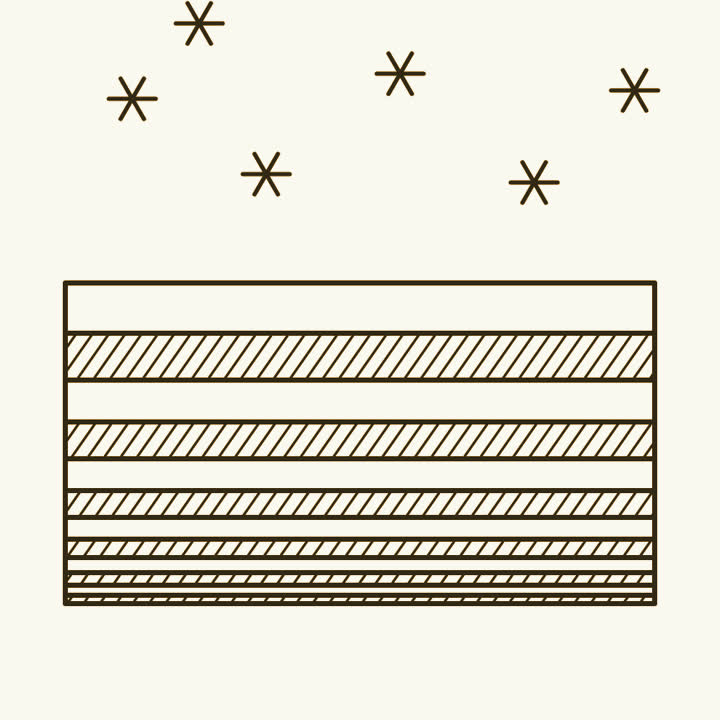
On the great ice sheets, the snow that falls does not melt away.
In the middle of Greenland and Antarctica, snow piles up year after year. Each year’s snow is buried by the next, and slowly squeezed into ice. Over hundreds of thousands of years, the ice has built up more than three kilometres thick in places. Drill down through it, and you travel back in time.
In 1952 Willi Dansgaard found that snow records how cold it was.
Dansgaard was a Danish scientist who studied rain and snow. He found that the mix of heavier and lighter forms of oxygen in snow depends on how cold it was where the snow formed. Colder snow holds less of the heavier form. So layers of old ice could act as an ancient thermometer.
In 1966, drillers at Camp Century reached the bottom of the Greenland ice.
Camp Century was an American military base built within the Greenland ice sheet. The drill passed through about one thousand three hundred and fifty metres of ice before reaching the ground beneath. Dansgaard asked to measure the oxygen in the core, and was given permission. The ice recorded the cold of the last ice age, and the warming that followed.
Ice cores can be read year by year, like tree rings.
Where plenty of snow falls, each year leaves a layer that can be told apart. Summer and winter snow differ in dust, in chemistry and in their mix of oxygen. By counting layers, scientists can date ice back tens of thousands of years. Deeper down, the layers are squeezed too thin to count, and other methods are used.
Bubbles in the ice hold samples of ancient air.
Near the surface, the snow is loose, and air moves through it. Some fifty to a hundred metres down, the snow turns to ice and seals the air into tiny bubbles. Scientists crush the ice in a vacuum and measure the gases that escape. That lets them measure the carbon dioxide in air from long before anyone was alive.
In Antarctica, a core from Dome C reached back about eight hundred thousand years.
A European team drilled at Dome C, reaching more than three kilometres down in 2004. The record covers eight cycles of ice ages and warmer periods. Through all of them, carbon dioxide rose and fell with temperature, mostly staying between about one hundred and eighty and two hundred and eighty parts per million. Today the level is more than four hundred and thirty.
So when you want to know how the world has changed, ask what it has left behind.
Snow that fell long ago still holds the temperature and the air of its time. Ice cores show carbon dioxide and temperature moving together through ice age after ice age. They also show that today’s level is far outside that long natural range. Teams are now drilling in Antarctica for ice more than a million years old.
Sources
- History of ice core science, Niels Bohr Institute, University of Copenhagen. From Dansgaard’s idea to the deep cores of Greenland.
- Ice core basics, AntarcticGlaciers.org. How ice cores are drilled, dated and read.
- Dating a core, Australian Antarctic Program. Counting layers, and what scientists do when they are too thin to count.
Nearby ideas
- The curve that tracks carbon dioxide. How patient measurements on a Hawaiian volcano revealed carbon dioxide rising.
- The rocks that revealed deep time. How rocks on a Scottish shore showed that the Earth is immensely old.
- The continents that drift. How matching coasts, fossils and rocks suggested that continents move.
- The magnetic stripes on the sea floor. How stripes of magnetism in the sea floor showed that the oceans are spreading.
- Dating the Earth, and finding lead everywhere. How measuring the age of the Earth uncovered lead pollution everywhere.
- The clay layer that pointed to an asteroid. How a thin layer of clay led to an asteroid, and a crater in Mexico.