Cobra Effect · Earth
The continents that drift
How matching coasts, fossils and rocks suggested that continents move.
7 cards, read aloud in 3:18, with a test and sources.
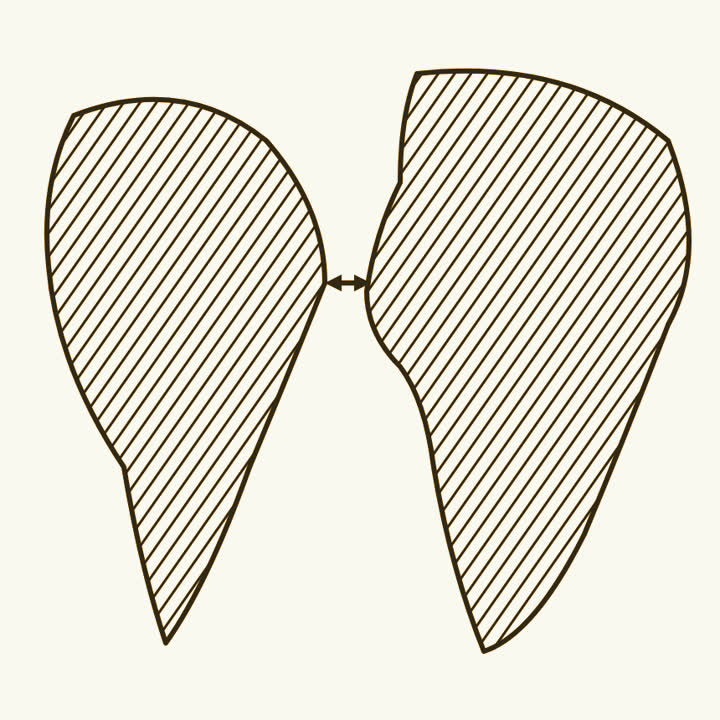
In 1912 Alfred Wegener suggested that the continents had once been joined together.
Wegener was a German scientist who studied the weather and the atmosphere, and explored Greenland. He was struck by how the coasts of South America and Africa fit together like jigsaw pieces. In January 1912 he proposed that the continents had slowly drifted apart. In 1915 he set out his evidence in a book.
The same fossils turned up on continents now separated by oceans.
Mesosaurus was a small reptile that lived in shallow water. Its fossils are found in both southern Africa and South America. It could not have swum across an ocean. Glossopteris, an ancient seed fern, is found in South America, Africa, India and Antarctica. If those lands had once been joined, these living things could have spread across them.
Rocks and mountains matched across the Atlantic too.
Rocks of the same kind and age appear on both sides of the ocean. The old mountains of eastern North America match mountains in Scotland and Scandinavia. Fit the continents back together, and the ranges line up. Wegener compared it to fitting together a torn newspaper, and finding that the lines of print still match.
Traces of ancient ice sheets lay in places that are now warm.
Rocks scratched and scraped by glaciers long ago are found in southern Africa, India and Australia. Today those places are far too warm for ice sheets. Wegener argued that these lands had once been joined together, much nearer the South Pole. Rather than the whole world having frozen, he said, the land itself had moved.
Most geologists rejected the idea, because nobody could explain how continents could move.
Wegener could not show what force was strong enough to push whole continents. The British geophysicist Harold Jeffreys argued that solid rock could not plough through the ocean floor. Many scientists explained the matching fossils with bridges of land that had since sunk. For decades, continental drift was treated as a fringe idea.
In November 1930, Wegener died on the Greenland ice.
He was on his fourth expedition to Greenland, studying the ice and the weather. He had travelled across the ice sheet to bring supplies to colleagues at a camp far inland. On the journey back, in bitter cold, he died, probably of heart failure. He did not live to see his idea accepted.
So when evidence fits but the explanation is missing, ask what else could be found.
Wegener’s evidence was strong, but his idea lacked a mechanism. In the 1960s, studies of the sea floor showed how the Earth’s plates move, and drift became part of plate tectonics. The Atlantic is still widening today, by a few centimetres a year. Being right too early can look a lot like being wrong.
Sources
- Alfred Wegener, NASA Earth Observatory. His life, his evidence, and the long road to plate tectonics.
- When continental drift was considered pseudoscience, Smithsonian Magazine. Why most geologists dismissed Wegener, and what changed their minds.
- Continental drift, Britannica. The evidence for drift, the objections, and how plate tectonics settled it.
Nearby ideas
- The rocks that revealed deep time. How rocks on a Scottish shore showed that the Earth is immensely old.
- The magnetic stripes on the sea floor. How stripes of magnetism in the sea floor showed that the oceans are spreading.
- Dating the Earth, and finding lead everywhere. How measuring the age of the Earth uncovered lead pollution everywhere.
- The clay layer that pointed to an asteroid. How a thin layer of clay led to an asteroid, and a crater in Mexico.
- The curve that tracks carbon dioxide. How patient measurements on a Hawaiian volcano revealed carbon dioxide rising.
- Ancient air trapped in ice. How bubbles and layers in polar ice record hundreds of thousands of years of climate.