Cobra Effect · Earth
The magnetic stripes on the sea floor
How stripes of magnetism in the sea floor showed that the oceans are spreading.
7 cards, read aloud in 3:30, with a test and sources.
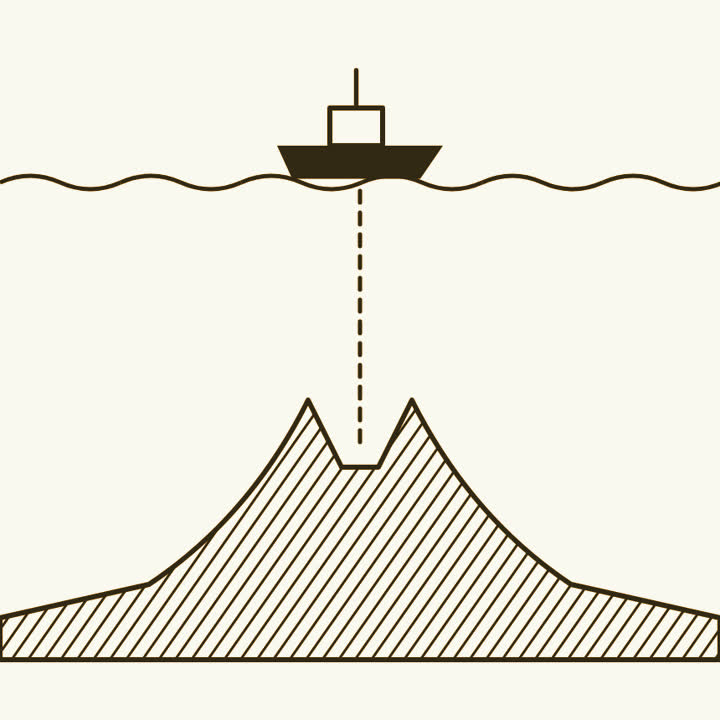
In the 1950s, Marie Tharp found a valley running along a vast mountain range under the Atlantic.
Tharp worked at Columbia University in New York, turning ships’ depth soundings into maps of the sea floor. She plotted a mountain range down the middle of the Atlantic, with a deep valley along its crest. Her colleague Bruce Heezen at first doubted it, but more soundings bore her out. Their maps of the ocean floor showed the ridge and its valley in striking detail.
In 1962 Harry Hess proposed that new sea floor forms along the ridges.
Hess was an American geologist who had surveyed the ocean floor while commanding a navy ship in the Second World War. He suggested that hot rock rises from deep below the mid-ocean ridges, and cools to make new sea floor. The new floor would spread away on both sides, like two conveyor belts. If he was right, the Atlantic was slowly growing wider.
The Earth’s magnetic field has flipped many times.
A compass points north because the Earth behaves like a giant magnet. When molten rock cools and hardens, tiny magnetic minerals in it lock in the direction of that field. Studies of old lava flows on land found rocks magnetised in the opposite direction. The field had reversed again and again over millions of years.
Ships towing magnetic sensors found a striped pattern on the sea floor.
Survey ships measured the magnetism of the sea floor along line after line. Off the west coast of North America, the readings formed long bands of stronger and weaker magnetism. The bands ran side by side, like the stripes of a zebra. At first nobody could explain them.
In 1963 Fred Vine and Drummond Matthews saw what the stripes meant.
As new sea floor forms at a ridge, it records the direction of the magnetic field at that time. When the field flips, the next strip of new floor records the opposite direction. So the stripes should form matching patterns on both sides of a ridge, like a mirror image. Lawrence Morley in Canada had the same idea, but journals turned his paper down.
Surveys found the mirror pattern, and drilling confirmed the ages.
Magnetic surveys across ocean ridges showed the stripes matching on either side. In 1968 the drilling ship Glomar Challenger began taking cores from the deep ocean floor. In the South Atlantic, the rock and sediment turned out to be older the farther they were from the ridge. Wegener’s drifting continents had found their mechanism, and the theory of plate tectonics took shape.
So when a pattern looks like noise, ask whether it could be a record.
The stripes looked meaningless until someone asked how they could have formed. Read as a record, they showed the sea floor spreading and the magnetic field flipping. The stripes are still being made today, wherever new sea floor forms. The most recent reversal of the magnetic field happened roughly seven hundred and eighty thousand years ago.
Sources
- Seeing is believing: how Marie Tharp changed geology forever, Smithsonian Magazine. The maps that revealed the rift valley, and the doubts she overcame.
- Frederick Vine and Drummond Matthews, The Geological Society. How two Cambridge geophysicists read the magnetic stripes.
- Developing the theory, US Geological Survey. From mapping the ocean floor to plate tectonics, step by step.
Nearby ideas
- The continents that drift. How matching coasts, fossils and rocks suggested that continents move.
- The rocks that revealed deep time. How rocks on a Scottish shore showed that the Earth is immensely old.
- Dating the Earth, and finding lead everywhere. How measuring the age of the Earth uncovered lead pollution everywhere.
- The clay layer that pointed to an asteroid. How a thin layer of clay led to an asteroid, and a crater in Mexico.
- The curve that tracks carbon dioxide. How patient measurements on a Hawaiian volcano revealed carbon dioxide rising.
- Ancient air trapped in ice. How bubbles and layers in polar ice record hundreds of thousands of years of climate.