Cobra Effect · Evolution
Evolution in a flask
How twelve flasks and a giant dish let scientists watch bacteria evolve.
7 cards, read aloud in 3:37, with a test and sources.
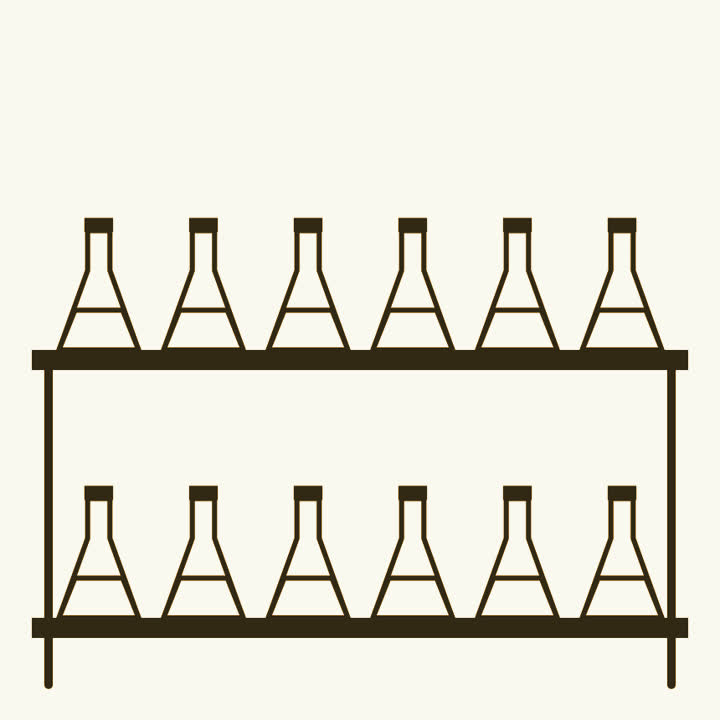
In February 1988, Richard Lenski set up twelve flasks of identical bacteria.
All twelve populations of E. coli came from the same ancestor. Each day, one per cent of each flask is moved into fresh food, and the bacteria grow again. Every five hundred generations, samples are frozen, so ancestors can later be revived beside their descendants. The experiment has kept going for decades.
Bacteria pass through generations fast enough to watch evolution over years.
Each day the bacteria in a flask double in number more than six times. By 2024 the populations had passed eighty thousand generations. For people, that many generations would stretch back more than a million years. Every step of the way can be checked against the frozen record.
In every flask, the bacteria came to grow faster than their ancestor.
Compared with the frozen ancestor, all twelve populations got better at growing on the food they were given. The gains were fastest early on, and slowed as the years went by. By twenty thousand generations, they grew about seventy per cent faster than the ancestor. Selection was fitting each population to life in the flask.
In one flask, after about thirty one thousand generations, something new appeared.
The food in the flasks includes citrate, which E. coli normally cannot use when there is oxygen around. Somewhere between generations thirty one thousand and thirty one thousand five hundred, one population began to feed on it. With a new food to eat, that flask grew much cloudier than the others. The team noticed it in 2003, and reported it in 2008.
Replaying the frozen history showed the new ability depended on earlier changes.
The team revived frozen samples from different points in that population’s past, and let them evolve again. The ability to use citrate was far more likely to evolve again in samples from after about generation twenty thousand. Earlier chance changes, with no obvious benefit at the time, had set the stage. Evolution can depend on the order in which chance changes happen.
A giant dish showed bacteria evolving to survive a thousand times the drug.
In 2016 a team at Harvard filled a long dish with bands of an antibiotic, none at the edges and strongest in the middle. They set bacteria at the edges, and filmed what happened. At each stronger band the bacteria stalled, until a mutant that could survive it broke through and spread. Within days they reached the middle, surviving a dose a thousand times stronger than the one that had killed their ancestors.
So when a treatment stops working, ask what it has been selecting for.
Every dose of an antibiotic kills the bacteria it can, and leaves any that happen to resist it. Those survivors multiply, and resistance spreads. In his Nobel lecture in 1945, Alexander Fleming warned that taking too little penicillin could make microbes resistant. Resistance is natural selection, working in hospitals, on farms and in our own bodies.
Sources
- E. coli long-term evolution experiment, Wikipedia. How the twelve flasks are kept, what has changed in them, and the citrate story.
- A cinematic approach to drug resistance, Harvard Gazette. The giant dish that let bacteria be filmed evolving resistance to an antibiotic.
- Penicillin: Nobel lecture, Alexander Fleming, 1945. Fleming’s lecture, ending with his warning about underdosing and resistance.
Nearby ideas
- Nature does the selecting. How mockingbirds, finches and a letter from Wallace led to the theory of evolution.
- The moth that turned black. How soot turned Britain’s peppered moths black, and clean air turned them pale again.
- The foxes that became friendly. How breeding the calmest foxes for a few decades changed their behaviour and their looks.
- Evolution you can watch. How two biologists measured every finch on one island and watched evolution happen.
- A fish with a neck and wrists. How a team predicted where to dig, and found a fish with a neck and wrists.