Cobra Effect · Evolution
A fish with a neck and wrists
How a team predicted where to dig, and found a fish with a neck and wrists.
7 cards, read aloud in 3:10, with a test and sources.
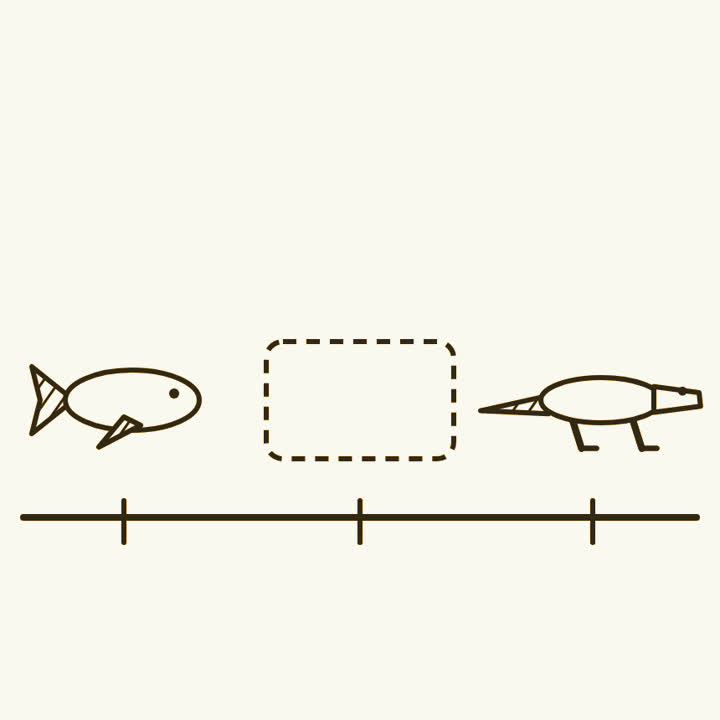
Fossils showed fish, and later animals with legs, but little in between.
Fish such as Panderichthys are known from rocks about three hundred and eighty million years old. Early animals with legs, such as Acanthostega, turn up in rocks about three hundred and sixty five million years old. If limbed animals evolved from fish, something in between should have lived in the fifteen million years that separate them. Good fossils from that gap were scarce.
Neil Shubin and Ted Daeschler went looking for rocks of just the right age.
They wanted rocks about three hundred and seventy five million years old. They wanted rocks laid down by rivers, where such a creature might have lived. And they wanted those rocks exposed at the surface, where fossils could be found. The Canadian Arctic had all three.
They searched Ellesmere Island, far north in the Arctic, from the year 2000.
The work could only be done in the brief Arctic summer, on bare rock in the wind and cold. For several summers they found nothing like what they were after. In 2004, in rock laid down by an ancient river, they found it. There were three skeletons of a creature no one had seen before.
A broad, flat skull came out of the rock.
Its eyes sat on top of its head, not on its sides. The team described it in the journal Nature in 2006. They named it Tiktaalik, from an Inuit word meaning a large freshwater fish. The name came from the people of Nunavut, where it was found.
Tiktaalik had scales, fins and gills, but also a neck.
Like a fish, it had scales, fins and gills. It also had lungs, and a neck that let it move its head without turning its whole body. A fish’s head is joined straight onto its shoulders. Land animals have necks. It was part fish, and part something new.
Inside its front fins were bones like those of a wrist.
Each front fin held one bone, then two bones, then a set of small wrist-like bones. Your own arm has the same plan: one upper arm bone, two forearm bones, then the wrist. The team argued that its fins were sturdy enough to prop up its body. The plan of your arm was already there in a fish.
So when a theory predicts something, ask where you would have to look to test it.
Evolution predicted that fish with limb-like features should have lived during one stretch of time. Knowing the age and kind of rock, the team could aim their search at one place on the map. If they had found a rabbit in those rocks instead, the theory would have been in serious trouble. They found the fish with a neck and wrists, where it should have been.
Sources
- Tiktaalik roseae: questions and answers with Neil Shubin, University of Chicago. The search, the fossil, and what it tells us about the move from water to land.
- Chance favored expedition leader in missing link discovery, Harvard Gazette. How the team chose where to search, and what they found in 2004.
- Your Inner Fish, Neil Shubin, 2008. The story of the search, and how our own bodies carry the plan of ancient fish.
Nearby ideas
- Nature does the selecting. How mockingbirds, finches and a letter from Wallace led to the theory of evolution.
- Evolution in a flask. How twelve flasks and a giant dish let scientists watch bacteria evolve.
- The foxes that became friendly. How breeding the calmest foxes for a few decades changed their behaviour and their looks.
- Evolution you can watch. How two biologists measured every finch on one island and watched evolution happen.
- The moth that turned black. How soot turned Britain’s peppered moths black, and clean air turned them pale again.