Cobra Effect · Evolution
The foxes that became friendly
How breeding the calmest foxes for a few decades changed their behaviour and their looks.
7 cards, read aloud in 3:19, with a test and sources.
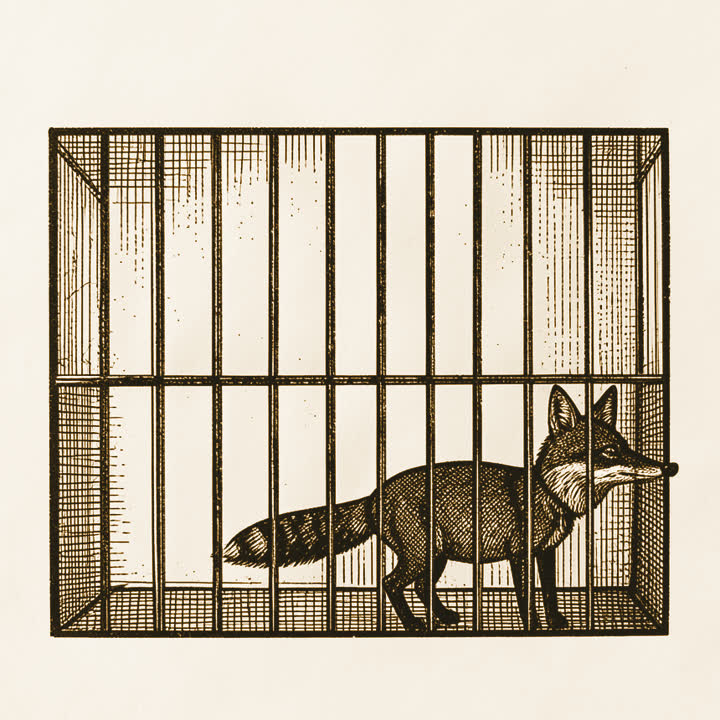
In 1959, in Siberia, Dmitry Belyaev set out to breed tame foxes.
Belyaev, a geneticist in Novosibirsk, wanted to understand how wolves had once become dogs. He started with silver foxes from fur farms, animals that were wary of people and often aggressive towards them. He decided to breed them for one thing only: how they behaved towards people. Lyudmila Trut joined him, and went on to lead the work for decades.
Each generation, only the tamest foxes were allowed to breed.
The team tested how each young fox reacted to people. Each fox was given a score for tameness, and nothing else counted. Only a small share of the calmest foxes, around a tenth to a fifth, became parents of the next generation. Everything else about the foxes was left to chance.
By the fourth generation, some foxes wagged their tails at people.
Some young foxes began to seek out the people who looked after them. The friendliest whimpered for attention, and sniffed and licked the experimenters, much like dogs. No one had trained them. They had simply been bred from calm parents. Behaviour, it turned out, could be changed by selection within a handful of generations.
With each generation, more of the foxes were eager for human company.
The team called the friendliest foxes the elite. By the tenth generation, eighteen per cent of the pups were elite. By the twentieth, thirty five per cent were. Decades later, the elite made up seventy to eighty per cent of the tame foxes.
Their bodies changed too, though no one had chosen that.
By around the tenth generation, some foxes had floppy ears and white patches in their coats, including a white star on the forehead. Some had curled tails, like many dogs. Their stress hormones changed as well: after twelve generations, levels had fallen to about half. Choosing for calm behaviour had brought other changes along with it.
The team also kept a line of foxes bred for aggression.
Alongside the tame foxes, they bred a separate line from the most fearful and aggressive animals. Those foxes stayed hostile towards people. Comparing the two lines helped to show that the difference was inherited, not just learned. The same kind of starting stock could be pushed in either direction.
So when you look at a dog, ask what its ancestors were chosen for.
Dogs descend from wolves, shaped over thousands of years of living alongside people. Belyaev’s foxes suggest how quickly selection for tameness alone can start that kind of change. Some scientists caution that farm foxes were never fully wild, so the changes may have had a head start. Even so, a few decades of choosing calm parents changed both behaviour and looks.
Sources
- Early canid domestication: the farm-fox experiment, Lyudmila Trut, American Scientist, 1999. Trut’s own account of the tame foxes, the elite, and the changes that came with them.
- Domesticated silver fox, Wikipedia. The history of the experiment, the aggressive line, the hormone findings and the later critique.
- The history of farm foxes undermines the animal domestication syndrome, Trends in Ecology and Evolution, 2019. Why some scientists think the farm foxes had a head start on tameness.
Nearby ideas
- Nature does the selecting. How mockingbirds, finches and a letter from Wallace led to the theory of evolution.
- Evolution you can watch. How two biologists measured every finch on one island and watched evolution happen.
- The moth that turned black. How soot turned Britain’s peppered moths black, and clean air turned them pale again.
- A fish with a neck and wrists. How a team predicted where to dig, and found a fish with a neck and wrists.
- Evolution in a flask. How twelve flasks and a giant dish let scientists watch bacteria evolve.