Cobra Effect · Evolution
The moth that turned black
How soot turned Britain’s peppered moths black, and clean air turned them pale again.
7 cards, read aloud in 3:31, with a test and sources.
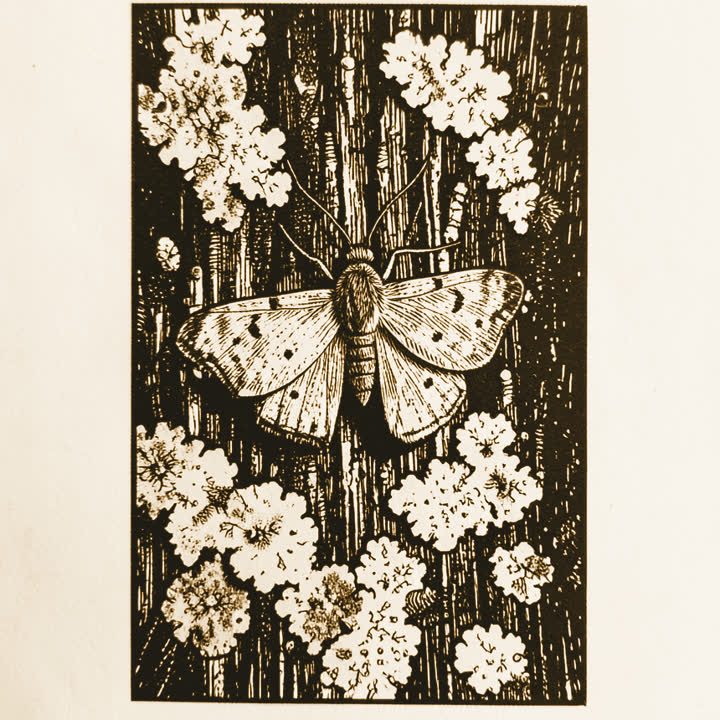
The peppered moth rests by day on trees, where its speckled wings are hard to see.
It flies at night, and spends the day still, on bark and branches. Its wings are pale and freckled with black, much like bark covered in pale lichen. Birds hunt by sight, so a moth that matches its background is harder to find. Before the middle of the nineteenth century, no black peppered moth had ever been recorded.
In 1848 a black peppered moth was caught in Manchester.
Manchester was one of the smokiest cities of the Industrial Revolution. Soot from coal fires blackened the trees around it, and the pollution killed off the pale lichens on the bark. Against dark trunks, pale moths stood out, and the rare black ones were hard to see. A black moth on sooty bark had a better chance of lasting the day.
By 1895, almost all the peppered moths around Manchester were black.
In less than fifty years, the black form went from a single record to about ninety eight per cent of the moths there. Black moths became common across the industrial parts of Britain. Where the air stayed clean, the pale form stayed common. Something was favouring black moths wherever the air was dirty.
In the 1950s Bernard Kettlewell set out to test whether birds were the reason.
He marked hundreds of peppered moths, pale and black, and released them in a polluted wood near Birmingham. Then he caught as many of them as he could again. He got back more than a quarter of the black moths, but only about one in eight of the pale ones. More of the moths that stood out had gone missing.
Birds really do pick off the moths that stand out.
Kettlewell watched birds take the conspicuous moths more readily than the camouflaged ones. Later scientists criticised parts of his methods, so the question was tested again. From 2001 to 2007, Michael Majerus released nearly five thousand moths in an unpolluted wood near his home, and watched what the birds ate. In that clean wood the birds took more of the black moths, which now stood out, enough to explain why black moths were becoming rare.
When the air was cleaned, the black moths became rare again.
After Britain’s Clean Air Act of 1956, smoke and soot fell, and lichens came back to the trees. Pale moths blended in once more, and black ones stood out. The share of black moths fell, and today they are rare where they were once almost everywhere. The same selection that made the moths black was now running the other way.
So when a trait sweeps through a population, ask what changed in the world around it.
In 2016 scientists found the change that makes a peppered moth black. A stretch of extra DNA had been inserted into a gene called cortex. Working back through the moths’ DNA, they estimated it first appeared around 1819, as the Industrial Revolution was well under way. The mutation was chance. Whether it spread depended on the colour of the trees.
Sources
- Peppered moth evolution, Wikipedia. The rise and fall of the black form, Kettlewell’s experiments, and the arguments over them.
- Selective bird predation on the peppered moth: the last experiment of Michael Majerus, Biology Letters, 2012. The seven-year study showing birds eat more of the moths that stand out.
- The industrial melanism mutation in British peppered moths is a transposable element, Nature, 2016. How the change in the gene cortex was found, and dated to around 1819.
Nearby ideas
- Nature does the selecting. How mockingbirds, finches and a letter from Wallace led to the theory of evolution.
- Evolution you can watch. How two biologists measured every finch on one island and watched evolution happen.
- A fish with a neck and wrists. How a team predicted where to dig, and found a fish with a neck and wrists.
- Evolution in a flask. How twelve flasks and a giant dish let scientists watch bacteria evolve.
- The foxes that became friendly. How breeding the calmest foxes for a few decades changed their behaviour and their looks.