Cobra Effect · Thinking and evidence
Bayesian updating
Change your mind in proportion to the strength of the evidence.
7 cards, read aloud in 3:07, with a test and sources.
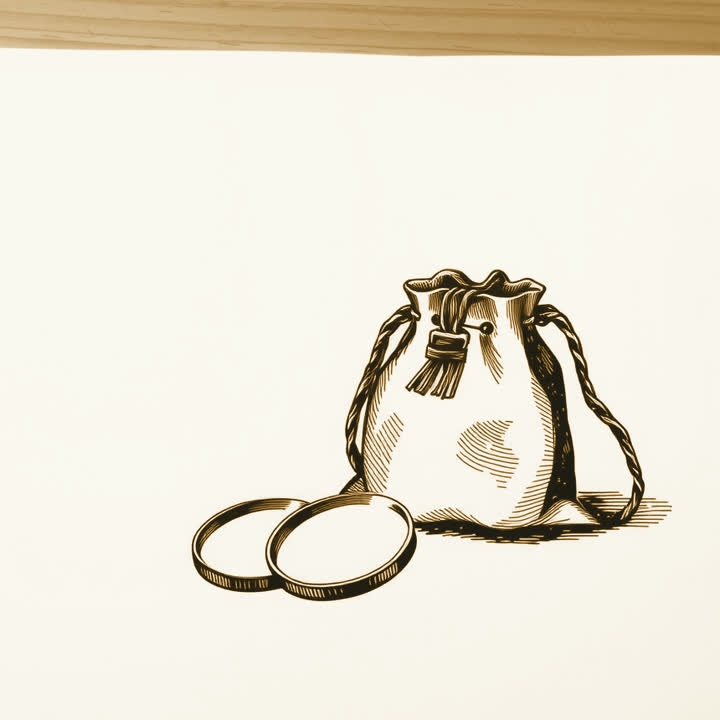
Two coins in a bag. One is fair. One has heads on both sides.
You pull one out without looking. You flip it. Heads. Which coin is in your hand? You can’t be sure. But you know more than you did.
Before the flip, it was even. Now it isn’t.
The fair coin gives heads half the time. The double headed coin gives heads every time. So heads was twice as likely if you are holding the trick coin, and your belief should move by the same amount. Two to one that it is the trick coin. Flip again. Heads again. Four to one. A third time, and it is eight to one.
That is Bayesian updating.
Thomas Bayes was an English minister who died in 1761. His friend Richard Price published the idea two years later. A belief is not a yes or a no. It is a number that says how sure you are. When evidence arrives, you ask one question. How much more likely is this if I am right than if I am wrong? Then you move your number by that much. No more, no less.
Notice what the coin never does.
Ten heads in a row and the trick coin is a thousand to one. Not certain. One tail and the fair coin wins outright, because the trick coin cannot do that. Strong evidence moves you a lot. Weak evidence moves you a little. A belief you started sure of needs a lot of evidence to shift, and that is right, not stubborn. What is wrong is refusing to move at all.
It found a missing submarine.
In 1968 the American submarine Scorpion vanished in the Atlantic. A naval scientist, John Craven, put a probability on every square of the search area and moved the numbers with each sonar pass that found nothing. The wreck was close to where the map said to look. The same method found the wreck of Air France flight 447 in 2011, two years after the crash.
Most people don’t update. They flip.
They hold a view at full strength until one bad day, and then hold the opposite at full strength. Or they hold it forever and call every piece of bad news an exception. Both are ways of never doing the sum. The sum is small. How sure was I? How surprising is this if I was wrong? Move a bit.
Try it with something you believe this week.
Write down how sure you are, as a number. Then write down what would move it up, and what would move it down. If nothing could move it down, it isn’t a belief. It is a wall. Bayes gave us a way to be wrong by degrees. Use it, and you will never have to be wrong all at once.
Sources
- Bayesian inference, Wikipedia. The method in full, with worked examples. The section on the history covers Bayes, Price and Laplace. Skip the formal parts and read the examples.
- The Signal and the Noise, Nate Silver, 2012. Forecasting in weather, poker, earthquakes and politics, with a chapter arguing that the Bayesian habit of moving beliefs by degrees is what separates the good forecasters from the rest.
- Thomas Bayes, Wikipedia. The minister himself, the essay found in his papers, and Richard Price, who saw what it was worth and got it published in 1763.
Nearby ideas
- Base rate neglect. A good test for a rare thing still gives mostly false alarms.
- Confirmation bias. We look for evidence that agrees, and rarely test what could say no.
- The problem of induction. A long run of past successes cannot prove the next one.
- Overconfidence. Why we feel more certain than our knowledge allows.
- The halo effect. One good quality colours how we judge all the others.
- Motivated reasoning. We set a lower bar for evidence we want to believe.
- The Texas sharpshooter fallacy. Draw the target after the shots and any pattern looks meaningful.
- The Semmelweis reflex. Why experts reject evidence that says they have done harm.