Cobra Effect · Science and philosophy
The problem of induction
A long run of past successes cannot prove the next one.
6 cards, read aloud in 2:19, with a test and sources.
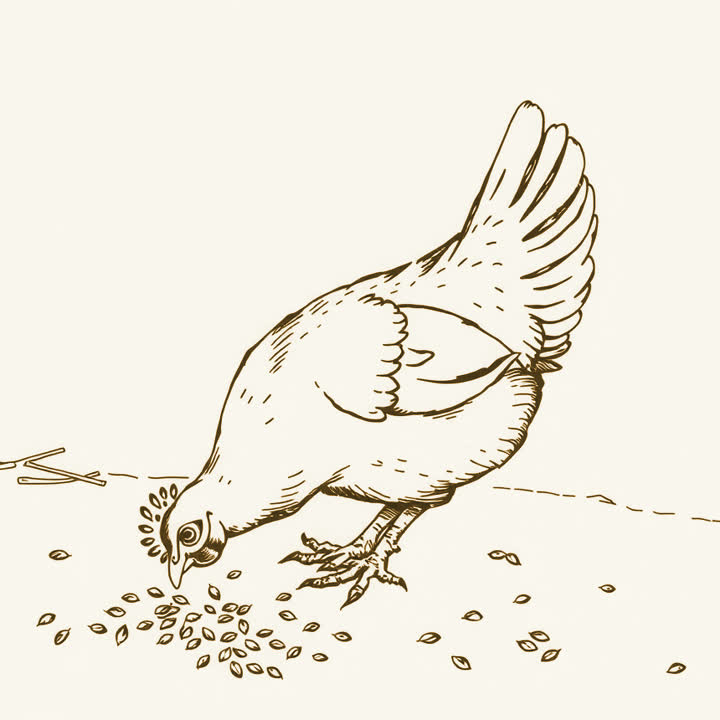
A chicken is fed every morning of its life.
Bertrand Russell tells it in 1912. Day after day, the farmer comes at dawn with grain. The chicken learns the rule. Farmer means food. Then one morning the farmer comes and wrings its neck.
The chicken did nothing wrong. That is the frightening part.
It had hundreds of days of evidence, all pointing the same way. Every extra morning made it more confident. The morning it was most sure was the morning it was wrong. Russell’s point was not about chickens.
David Hume saw the problem in 1739.
Every claim about the future rests on the past. The sun rose yesterday, and every day before, so it will rise tomorrow. But why should the future resemble the past? The only answer is that it always has. Which is the past again. That circle is the problem of induction.
No number of white swans proves that all swans are white.
Europeans believed it for centuries. Then in 1697 Dutch sailors saw black swans in Western Australia. One bird undid every white swan ever seen. Evidence can pile up for a rule forever. It can never make the rule certain.
Science runs on induction anyway.
Every law of nature is a pattern we have seen so far. Karl Popper’s answer was to stop trying to prove and start trying to break. A theory earns its keep by surviving attempts to kill it. You never get certainty. You get a theory that hasn’t died yet.
Live like a chicken who has read Russell.
The past is the best guide you have. Use it. But notice when your confidence comes only from a long run of nothing going wrong. The house that has never flooded. The company that has never missed a payment. Ask what the morning it fails would look like, and whether you would see it coming. The chicken couldn’t. You can try.
Sources
- Problem of induction, Wikipedia. Hume’s argument, Russell’s chicken, the black swans, and the answers philosophers have tried since.
- The Problems of Philosophy, Bertrand Russell, 1912. Short, clear and free. Chapter six, On Induction, has the chicken. The whole book is a good first philosophy book and is on Project Gutenberg.
- The Problem of Induction, Stanford Encyclopedia of Philosophy. The serious survey. Hume’s original argument laid out step by step, then every major reply, with the objections to each.
Nearby ideas
- Survivorship bias. The failures you never see can reverse the lesson you draw.
- The razors. Simple rules for cutting away explanations you do not need.
- Regression to the mean. Extreme results drift back towards normal, whatever you do.
- The ship of Theseus. Replace every part, and ask whether it is still the same thing.
- The trolley problem. Why harm that follows from a plan feels different from harm that is the plan.
- The placebo effect. Much of what a dummy pill seems to do would have happened anyway.
- The replication crisis. Why many famous findings vanished when others tried them again.
- Cargo cult science. Science can copy every outward form and still miss the honesty.