Cobra Effect · Particles
The particle with no charge
How recoiling atoms revealed a particle that leaves no track.
7 cards, read aloud in 2:53, with a test and sources.
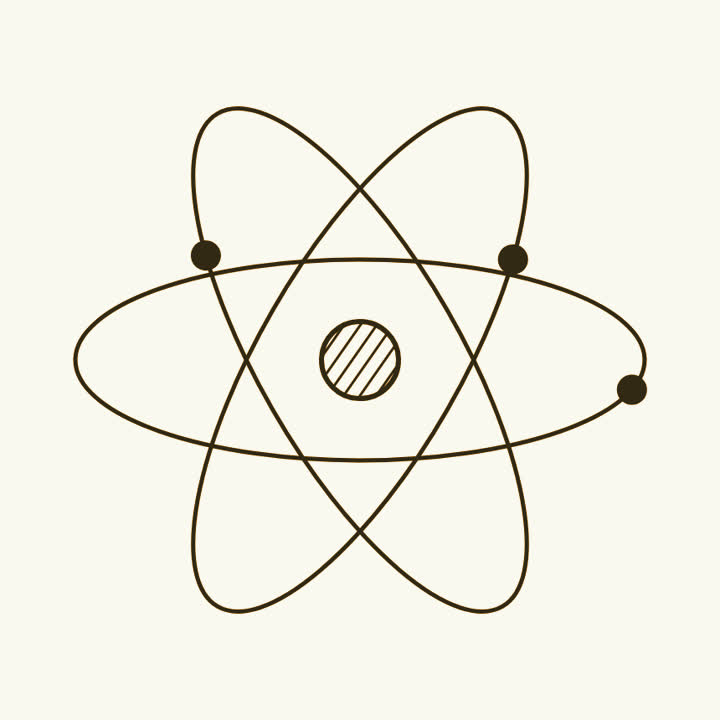
By 1930, atoms were known to have a tiny, heavy centre surrounded by electrons.
But the centres of most atoms were heavier than their charge could explain. As early as 1920, Ernest Rutherford had suggested that a neutral particle might be hiding there. Nobody had found one.
In Germany, experimenters found a strange, penetrating radiation.
In 1930, Walther Bothe and Herbert Becker fired alpha particles from polonium at the metal beryllium. Out came radiation that passed through thick material and carried no charge. They took it for a powerful kind of gamma ray, which is a form of light.
In Paris, Irene Joliot-Curie and Frederic Joliot found that it knocked protons out of wax.
In January 1932, they aimed the radiation at paraffin wax, and fast protons shot out. They explained it as gamma rays of enormous energy. But to knock protons out so hard, the rays would have needed far more energy than seemed possible.
At Cambridge, James Chadwick doubted that gamma rays could do that.
He repeated the experiment, aiming the radiation at many different materials. It knocked atoms out of hydrogen, helium, lithium, carbon, and others. He measured how hard each kind of atom was knocked.
The recoils fitted a particle about as heavy as a proton, with no charge at all.
A burst of light could not knock heavy atoms around like that. But a neutral particle with a proton’s mass could, like one billiard ball striking another. In February 1932, he published a short letter titled Possible Existence of a Neutron.
The neutron completed the basic picture of the atom.
Every atom’s centre is built from protons and neutrons, with electrons around it. Because neutrons have no charge, they can slip into the centre of an atom without being pushed away. That later made neutrons the key to splitting atoms, for nuclear power and for nuclear weapons. Chadwick won the Nobel Prize in Physics in 1935. That same year, the Joliot-Curies won the chemistry prize, for other work.
So when an explanation needs something wildly extreme, look for a simpler hidden cause.
The Paris team needed gamma rays of implausible energy. Chadwick asked what else could produce the same recoils. An uncharged particle did it without stretching anything. Nobody saw the neutron. The atoms it knocked out gave it away.
Sources
- Possible Existence of a Neutron, James Chadwick, Nature, 1932. The short letter announcing the neutron.
- The neutron and its properties, James Chadwick, Nobel lecture, 1935. Chadwick’s own account of the discovery.
- Discovery of the neutron, Wikipedia. The full story, from Rutherford’s idea to Chadwick’s letter.
Nearby ideas
- The particle smaller than an atom. How a bent beam in a glass tube revealed the first particle smaller than an atom.
- The mirror image of the electron. How an equation predicted antimatter, and a cloud chamber photograph found it.
- The ghost particle that took decades to catch. How a desperate guess about missing energy led to catching a ghostly particle.
- The particle that revealed a hidden field. How a 1964 prediction about mass was confirmed at CERN in 2012.
- The radiation that came from the sky. How balloon flights showed that radiation pours in from space.