Cobra Effect · Particles
The ghost particle that took decades to catch
How a desperate guess about missing energy led to catching a ghostly particle.
7 cards, read aloud in 3:04, with a test and sources.
In the 1920s, one kind of radioactivity seemed to break a basic rule of physics.
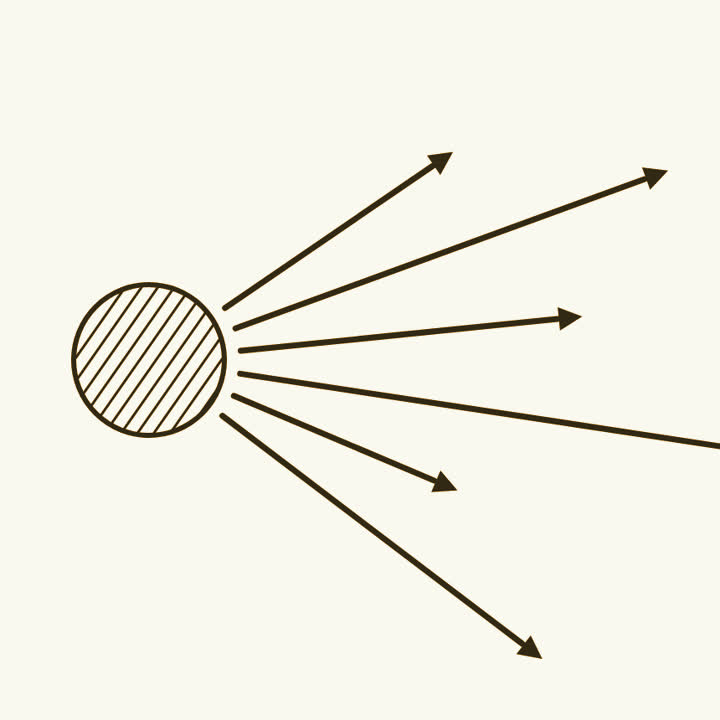
In beta decay, the centre of an atom shoots out an electron. The electrons came out with a spread of different energies, as if some energy simply went missing. Even Niels Bohr considered giving up the rule that energy is always conserved.
In December 1930, Wolfgang Pauli proposed what he called a desperate remedy.
He wrote an open letter to physicists meeting in Tubingen, beginning, Dear Radioactive Ladies and Gentlemen. He suggested that an unseen neutral particle flew out with each electron, carrying off the missing energy. He could not come to the meeting, he explained, because he was needed at a ball in Zurich. He did not yet dare to publish the idea.
Such a particle would be almost impossible to detect.
With no charge and very little mass, it would pass through matter almost untouched. Pauli had called it a neutron, but that name went to the heavier particle Chadwick found, so Enrico Fermi called it the neutrino. In 1934, two physicists calculated that there was no practical way to observe it.
In the early 1950s, Clyde Cowan and Frederick Reines decided to try anyway.
They first planned to use a nuclear bomb explosion as the source. Instead they turned to a nuclear reactor, which gives off enormous numbers of these particles. They called the effort Project Poltergeist.
Beside the Savannah River reactor, they built a detector with a double signature.
Tanks of water sat between tanks of a liquid that flashes when particles pass through it. A neutrino striking a proton would make two flashes, one at once and another a few millionths of a second later. That pair of flashes was hard for anything else to fake. With the reactor running, they caught a few such pairs every hour.
In June 1956, they sent Pauli a telegram.
It told him they had definitely detected neutrinos. Pauli read it out to a meeting at CERN, in Geneva. His reply, that everything comes to him who knows how to wait, never reached them. In 1995, Reines shared the Nobel Prize in Physics. Cowan had died in 1974.
So when something seems to vanish, ask whether it slipped away unseen.
Pauli refused to believe that energy really disappeared. He proposed a particle so elusive that few expected it would ever be caught. A quarter of a century later, patient experiment caught it. Every second, trillions of neutrinos from the Sun pass straight through your body.
Sources
- From poltergeist to particle, Frederick Reines, Nobel lecture, 1995. Reines tells the story, including the telegram and Pauli’s lost reply.
- Ghosts in the machine, CERN Courier. How Cowan and Reines caught the neutrino.
- Pauli’s neutrino letter, CERN timeline. The 1930 letter that proposed the particle.
Nearby ideas
- The particle with no charge. How recoiling atoms revealed a particle that leaves no track.
- The radiation that came from the sky. How balloon flights showed that radiation pours in from space.
- The particle that revealed a hidden field. How a 1964 prediction about mass was confirmed at CERN in 2012.
- The particle smaller than an atom. How a bent beam in a glass tube revealed the first particle smaller than an atom.
- The mirror image of the electron. How an equation predicted antimatter, and a cloud chamber photograph found it.