Cobra Effect · Particles
The particle smaller than an atom
How a bent beam in a glass tube revealed the first particle smaller than an atom.
7 cards, read aloud in 2:58, with a test and sources.
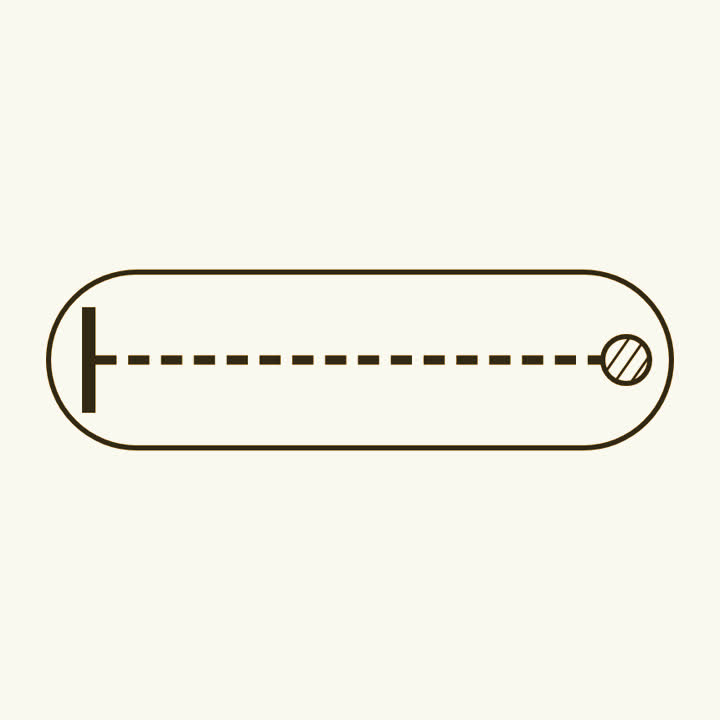
In the 1890s, physicists argued about the glowing beams inside empty glass tubes.
When electricity crossed a tube with most of the air pumped out, a beam streamed from one end. These cathode rays made the glass glow where they struck. Some physicists thought they were a kind of wave. Others thought they were streams of particles. At Cambridge, J. J. Thomson set out to settle it.
Thomson bent the beam with magnets, and with electrically charged plates.
Earlier experiments had struggled to bend the rays with charged plates. With far more of the air pumped out, Thomson made them bend clearly. They swerved toward the positive plate, so they carried negative charge. How sharply they bent depended on how heavy each particle was, compared with its charge.
The result was astonishing.
The mass of each particle, compared with its charge, was roughly a thousand times smaller than for the lightest charged atom known. It came out the same whatever gas was in the tube. So the particles were not bits of one kind of atom. They seemed to be part of every atom.
In April 1897, he announced that atoms contain much smaller particles.
He spoke at the Royal Institution in London, and published his full results later that year. He called the particles corpuscles. Other scientists preferred the name electron, a word already in use for the basic unit of charge, and that name stuck.
Two years later, he measured the charge itself.
That let him work out the mass. Each particle was far lighter than even a hydrogen atom. Other physicists, including Walter Kaufmann in Germany, had measured the same ratio in 1897. But Thomson was the one who argued that here was a new particle, smaller than any atom.
Thomson won the Nobel Prize in Physics in 1906.
The prize honoured his work on how electricity passes through gases. In 1904 he suggested a model of the atom, with electrons dotted through a ball of positive charge. Later experiments showed the positive charge is packed into a tiny centre instead. In 1937 his son, George, shared a Nobel Prize for showing that electrons also behave like waves.
So when a result stays the same whatever you change, ask what it is telling you.
Thomson changed the gas in the tube, and the particles did not change. That sameness was the clue that they belonged to all matter. Electrons now carry the current in every wire, and hold the chemistry of every atom together.
Sources
- J. J. Thomson, Biographical, NobelPrize.org. His life and the 1897 lecture announcing the corpuscle.
- Joseph John “J. J.” Thomson, Science History Institute. How Thomson found the first particle smaller than an atom.
- Cathode Rays, J. J. Thomson, 1897, annotated by Carmen Giunta. The full 1897 paper, with notes.
Nearby ideas
- The radiation that came from the sky. How balloon flights showed that radiation pours in from space.
- The mirror image of the electron. How an equation predicted antimatter, and a cloud chamber photograph found it.
- The particle with no charge. How recoiling atoms revealed a particle that leaves no track.
- The ghost particle that took decades to catch. How a desperate guess about missing energy led to catching a ghostly particle.
- The particle that revealed a hidden field. How a 1964 prediction about mass was confirmed at CERN in 2012.