Cobra Effect · Particles
The radiation that came from the sky
How balloon flights showed that radiation pours in from space.
7 cards, read aloud in 2:47, with a test and sources.
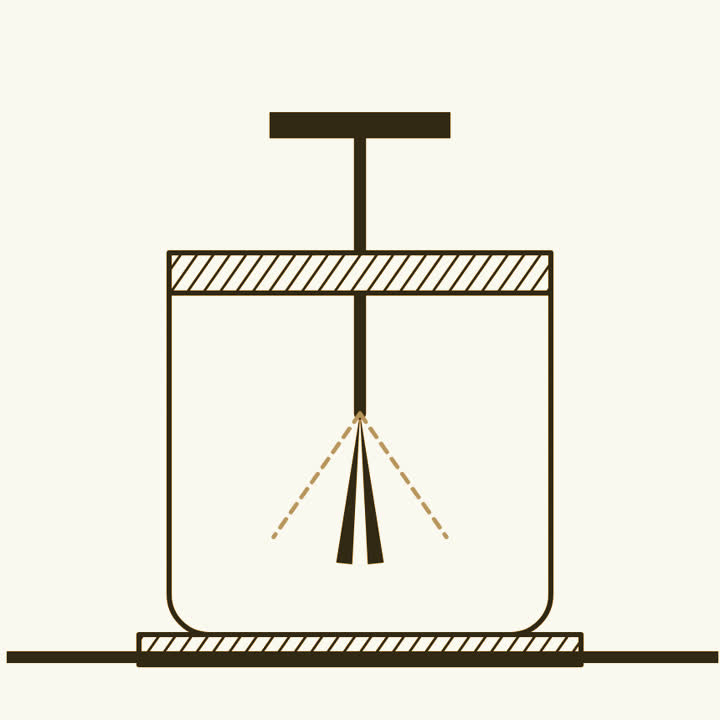
In the early 1900s, instruments kept losing their electric charge for no clear reason.
A charged electroscope slowly lost its charge, even when sealed and shielded. Something was making the air inside it conduct electricity. Most scientists thought the cause was radiation from rocks in the ground. If so, it should grow weaker the higher you went.
Measurements higher up gave puzzling results.
Readings at the top of the Eiffel Tower did not fall as much as expected. Early balloon flights gave no clear answer. Victor Hess, a young Austrian physicist, decided to carry sensitive instruments much higher.
In 1912, Hess made a series of balloon flights.
He carried airtight electroscopes and read them himself as the balloon rose. One flight took place during a partial eclipse of the Sun. The radiation did not drop while the Sun was partly covered. He flew at night too, and the radiation was still there.
In August 1912, he rose more than five thousand metres into the sky.
The balloon took off early in the morning from Aussig, in what is now the Czech Republic. At first the radiation fell a little. Then, as he climbed higher, it rose steeply. Near the top of the flight, it was around twice as strong as on the ground.
Hess concluded that powerful radiation was pouring into the atmosphere from above.
It was not coming from the Sun, since it did not fade at night or during the eclipse. Later instruments carried on higher balloons found it stronger still. The name cosmic rays caught on later.
Cosmic rays turned out to be particles from space, arriving with tremendous energy.
Most are the nuclei of atoms, mainly protons, crashing into the upper atmosphere. The collisions send showers of new particles down toward the ground, some of them unknown before. In 1936, Hess shared the Nobel Prize in Physics for the discovery. Two years later, after Nazi Germany took over Austria, he lost his post and moved to the United States.
So when the obvious explanation predicts something, go and check it.
Everyone expected the radiation to fade with height. Hess took the question up in a balloon basket and read the instruments himself. The measurement turned the obvious answer upside down. Sometimes a discovery waits only for someone to measure where no one has.
Sources
- A discovery of cosmic proportions, CERN Courier. Hess’s 1912 flights, in his own words.
- Victor F. Hess, Facts, NobelPrize.org. The 1936 Nobel Prize for the discovery of cosmic radiation.
- On the observations of penetrating radiation during seven free balloon flights, Victor Hess, 1912, English translation on arXiv. The original paper describing the flights.
Nearby ideas
- The particle smaller than an atom. How a bent beam in a glass tube revealed the first particle smaller than an atom.
- The mirror image of the electron. How an equation predicted antimatter, and a cloud chamber photograph found it.
- The particle with no charge. How recoiling atoms revealed a particle that leaves no track.
- The ghost particle that took decades to catch. How a desperate guess about missing energy led to catching a ghostly particle.
- The particle that revealed a hidden field. How a 1964 prediction about mass was confirmed at CERN in 2012.