Cobra Effect · Thinking and evidence
The curse of knowledge
Once you know something, you cannot see what a beginner is missing.
6 cards, read aloud in 2:22, with a test and sources.
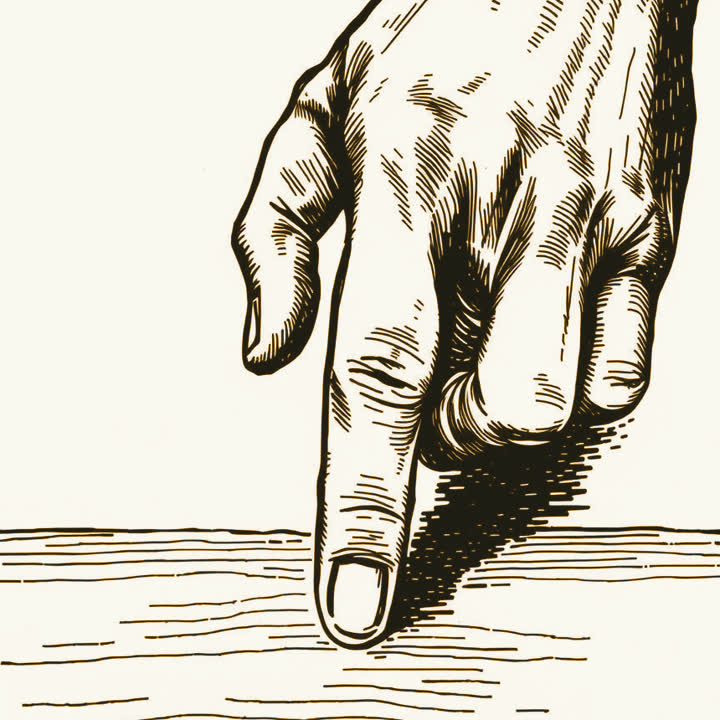
Tap out a song on the table. Just the rhythm.
Happy Birthday, say. In your head the tune is playing, the words, the whole thing. To the person across the table it is a series of knocks. How likely are they to name the song?
Stanford, 1990. Elizabeth Newton ran that experiment.
Tappers tapped well known songs. Listeners guessed. Before they began, the tappers predicted that listeners would get about half of the songs right. The listeners got 2.5%. Three songs out of 120.
The tappers weren’t stupid. They were cursed.
Once you know the tune, you cannot hear the knocks as knocks. You hear the song. You cannot un-hear it. Newton’s tappers were amazed at how slow the listeners were. The listeners, hearing only a rhythm, were amazed that anyone expected them to guess.
That is the curse of knowledge.
Once you know something, you find it hard to imagine not knowing it. Three economists named it in 1989, studying how better informed people mispredict what the less informed will do. Chip and Dan Heath made the tapping study famous in 2007. The knowledge is the problem. It rewrites your idea of what is obvious.
It is why experts write badly and teachers lose their class.
Steven Pinker calls it the chief cause of unclear writing. The writer knows what the jargon means, so it doesn’t feel like jargon. The teacher solved this problem twenty years ago, so the hard step doesn’t feel like a step. The manager sends a two line email that makes perfect sense to the one person who wrote it.
There is no cure. There is a test.
You cannot forget what you know, so stop trying to guess what is obvious. Give the thing to someone who doesn’t know it, and watch them. Not ask them. Watch. Write for the person you were the week before you understood. If they can’t hear the tune, the fault is in the tapping.
Sources
- Curse of knowledge, Wikipedia. Newton’s 1990 tapping study, the 1989 paper by Camerer, Loewenstein and Weber that named the idea, and where it shows up in teaching, sales and writing.
- Made to Stick, Chip Heath and Dan Heath, 2007. The book that made the tappers famous. Why some ideas survive and others die, with the curse of knowledge as the villain of the introduction.
- The Sense of Style, Steven Pinker, 2014. A writing guide by a psychologist. Chapter three is on the curse of knowledge, and argues it is the main reason clever people write badly.
Nearby ideas
- The Dunning Kruger effect. Why the least skilled are often the worst judges of their skill.
- Hindsight bias. Once you know the ending, it always looks obvious.
- The Feynman technique. If you cannot explain it simply, you have found a gap.
- Bayesian updating. Change your mind in proportion to the strength of the evidence.
- Overconfidence. Why we feel more certain than our knowledge allows.
- The halo effect. One good quality colours how we judge all the others.
- Motivated reasoning. We set a lower bar for evidence we want to believe.
- The Texas sharpshooter fallacy. Draw the target after the shots and any pattern looks meaningful.