Cobra Effect · Thinking and evidence
The Dunning Kruger effect
Why the least skilled are often the worst judges of their skill.
5 cards, read aloud in 1:32, with a test and sources.
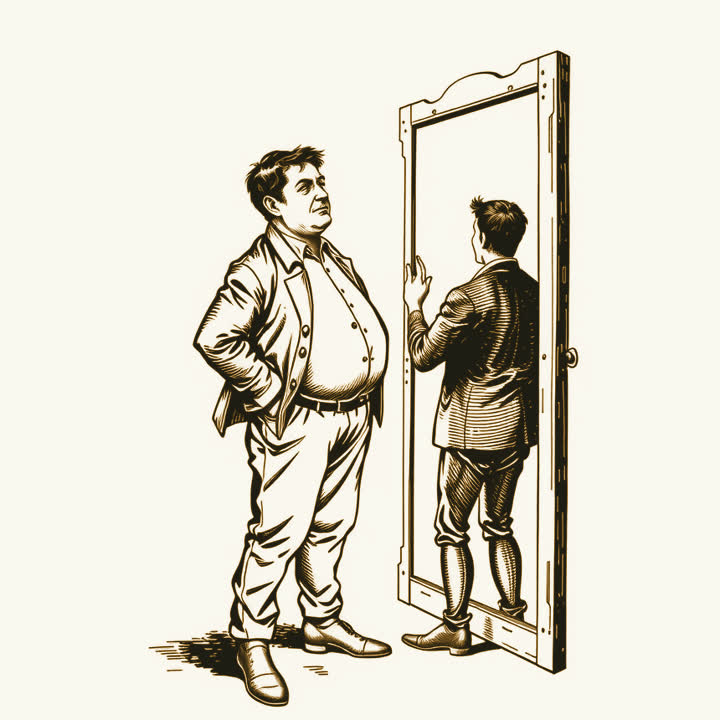
1999. Two psychologists test people on logic, grammar and humour.
David Dunning and Justin Kruger asked their subjects to guess how well they had done. The people who scored lowest guessed they were above average. The people who scored highest guessed a little low.
The skill you need to do a thing is the skill you need to judge it.
If you can’t write a good sentence, you can’t tell that yours is bad. Beginners aren’t arrogant. They are missing the instrument that would show them the gap.
The famous graph is a meme, not the paper.
The steep peak of confidence followed by a valley of despair is a later invention. The real effect is smaller and flatter. The bottom quarter overrate themselves, the top quarter slightly underrate. That is all, and it is enough.
Experts have the opposite problem.
They know how much they don’t know. And they assume the thing that is easy for them is easy for everyone. So they guess low.
The only fix is a test you can’t argue with.
Feeling confident is not evidence. Being asked a question and getting it wrong is. So never rate how well you know something. Get someone, or something, to ask you the question.
Sources
- Unskilled and Unaware of It, Justin Kruger and David Dunning, 1999. The original paper, in the Journal of Personality and Social Psychology. Search the title with the year. The article summarises the four studies and the debate since.
- Self-Insight: Roadblocks and Detours on the Path to Knowing Thyself, David Dunning, 2005. Dunning’s own book length account of why people misjudge themselves, by the man whose name is on the finding. His Wikipedia page lists it with the rest of his work.
- The Dunning-Kruger Effect Is Probably Not Real, Jonathan Jarry, McGill Office for Science and Society, 2020. The best short account of why the famous peak and valley graph is a meme and how much of the original finding may be a statistical artefact. Read it before you cite the idea at anyone.
Nearby ideas
- The razors. Simple rules for cutting away explanations you do not need.
- The spacing effect. Spread your study out over time and it lasts far longer.
- The Peter principle. Why people get promoted until they reach a job they cannot do.
- Confirmation bias. We look for evidence that agrees, and rarely test what could say no.
- The planning fallacy. Why projects nearly always take longer than we plan.
- Base rate neglect. A good test for a rare thing still gives mostly false alarms.
- Anchoring. The first number you hear bends every estimate that follows.
- The availability heuristic. Vivid stories make rare dangers feel common.