Cobra Effect · Weather and climate
The first public weather forecasts
How a storm, a telegraph and a sea captain gave us the weather forecast.
7 cards, read aloud in 2:46, with a test and sources.
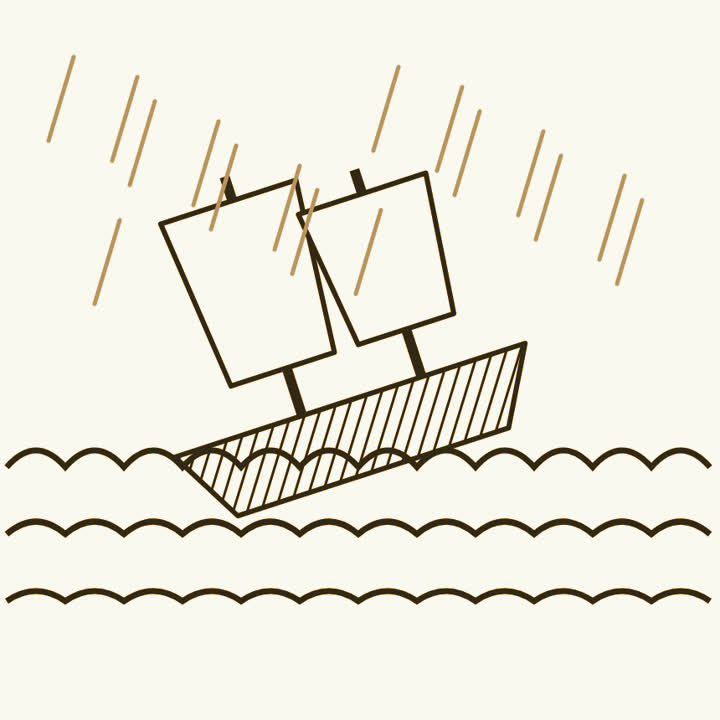
In October 1859, a violent storm struck the coasts of Britain.
The steam clipper Royal Charter, on its way home from Australia, was wrecked off Anglesey in Wales. Around four hundred and fifty people aboard died. More than a hundred other ships were lost in the same storm. Nobody had warned them it was coming.
Robert FitzRoy believed storms like it could be seen coming.
FitzRoy was a naval officer who had once captained HMS Beagle, with Charles Darwin aboard. In 1854 he became head of a new Meteorological Department, set up to help ships at sea. He knew that falling air pressure, shown on a barometer, often meant a storm was near.
The telegraph let him see the weather across the country at once.
Observers at stations around the coast sent him their readings by telegraph. Plotting them together, he could watch storms take shape and move. From 1861, he sent storm warnings to ports, where signals were hoisted on tall poles.
In August 1861, The Times printed his first public weather forecasts.
FitzRoy called them forecasts, a word he chose for the job. They looked a day or two ahead, and were very general. When they went wrong, critics were quick to mock them.
Many men of science thought forecasting was not proper science.
They argued that his methods did not rest on firm theory. Criticism of his work came to a head in 1865. Worn down by overwork and attacks on his work, FitzRoy took his own life that April. In 1866 his public forecasts were stopped, and by the end of that year his storm warnings too.
In time, the warnings and forecasts came back.
Public forecasts returned in 1879. The Met Office traces its founding to FitzRoy’s department. Britain’s shipping forecast grew from his storm warnings. Forecasts now use satellites and supercomputers, but they begin as his did, with readings from many places at once.
So when a prediction is sometimes wrong, ask whether it is still better than none.
FitzRoy’s forecasts were rough, and critics judged them by their misses. But a warning that is right more often than not can still save lives at sea. Useful science often begins with rough predictions, and improves them one mistake at a time.
Sources
- Robert FitzRoy and the early Met Office, Met Office. How FitzRoy built storm warnings and the first forecasts.
- The Royal Charter Gale, Met Office. The 1859 storm that led to the first warnings.
- Robert FitzRoy, Darwin Correspondence Project. FitzRoy’s life, from the Beagle to the Meteorological Department.
Nearby ideas
- The rounded number that changed the forecast. How a rounded number revealed why the weather can't be forecast far ahead.
- The warm water that shifts the world’s weather. How warm water off Peru turned out to steer rain and drought around the world.
- The climate model that passed the test of time. How a simple computer model predicted climate change decades before it arrived.
- The gases that trap heat. How two experiments showed that a few invisible gases keep the Earth warm.
- A year of sums about carbon dioxide. How a chemist with a pencil made the first estimate of global warming.