Cobra Effect · Weather and climate
The rounded number that changed the forecast
How a rounded number revealed why the weather can't be forecast far ahead.
7 cards, read aloud in 2:59, with a test and sources.
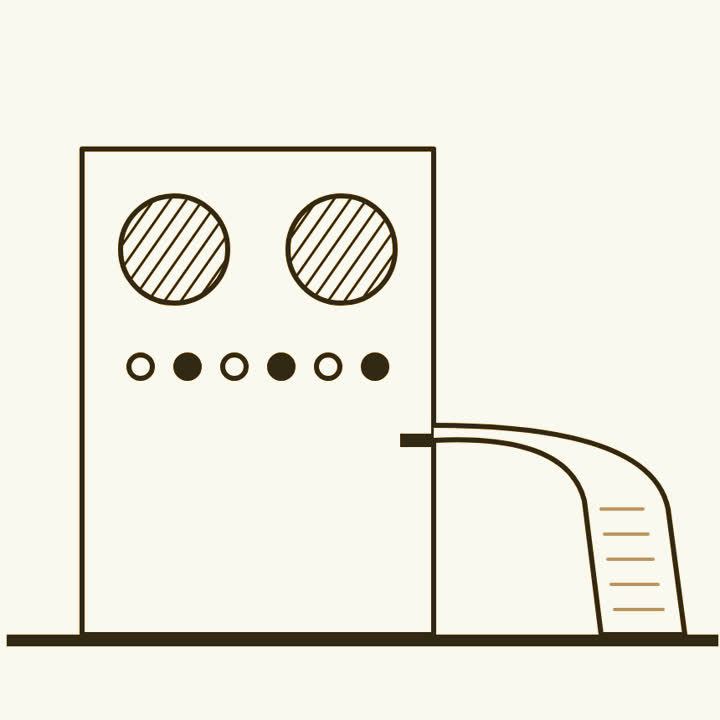
In 1961, Edward Lorenz was running a simple model of the weather on a computer.
Lorenz was a meteorologist at the Massachusetts Institute of Technology. His model boiled the weather down to twelve numbers, such as temperature and wind speed. The computer printed out how those numbers changed, step by simulated step. One day, he wanted to look again at part of a run.
To save time, he restarted the run halfway, typing in numbers from a printout.
The printout showed three decimal places, though the computer kept six. So instead of 0.506127, he typed 0.506. Then he went to get a cup of coffee while the machine ran.
When he came back, the new weather looked nothing like the old.
At first the two runs matched closely. Then they drifted apart, and after about two months of simulated weather they were completely different. The tiny rounding had grown, step by step, into a different forecast. The computer was working perfectly.
Lorenz realised the real atmosphere might behave the same way.
In a system like the weather, tiny differences in the starting state can grow until they swamp everything else. Nobody can measure the whole atmosphere perfectly. So there must be a limit to how far ahead the weather can be forecast in detail. He published the idea in 1963, in a paper titled Deterministic Nonperiodic Flow.
In 1972, he gave a talk with a famous question for a title.
It asked whether the flap of a butterfly’s wings in Brazil could set off a tornado in Texas. The title was suggested by another meteorologist, Philip Merilees. Lorenz had earlier used a seagull as his example. His point was not that butterflies cause tornadoes, but that tiny changes make long forecasts uncertain.
Forecasters now run many forecasts at once, each starting slightly differently.
When the runs agree, forecasters can be confident. When they spread apart, less so. Detailed forecasts are now useful for about a week or more ahead. Beyond about two weeks, the limit Lorenz described still holds as a rough guide.
So when a long forecast looks precise, ask how much a tiny error would change it.
Some systems are steady, and small errors stay small. Others, like the weather, magnify them. In those, the honest forecast is a range of outcomes, not a single answer. Knowing the limits of prediction is a discovery in its own right.
Sources
- When the Butterfly Effect Took Flight, MIT Technology Review. How a rounded number led Lorenz to the limits of forecasting.
- Circa January 1961: Lorenz and the Butterfly Effect, APS News. The 1961 computer run and what followed.
- Edward Norton Lorenz, Wikipedia. His life and work, with links to the 1963 paper.
Nearby ideas
- The first public weather forecasts. How a storm, a telegraph and a sea captain gave us the weather forecast.
- The warm water that shifts the world’s weather. How warm water off Peru turned out to steer rain and drought around the world.
- The climate model that passed the test of time. How a simple computer model predicted climate change decades before it arrived.
- The gases that trap heat. How two experiments showed that a few invisible gases keep the Earth warm.
- A year of sums about carbon dioxide. How a chemist with a pencil made the first estimate of global warming.