Cobra Effect · Weather and climate
The climate model that passed the test of time
How a simple computer model predicted climate change decades before it arrived.
7 cards, read aloud in 2:40, with a test and sources.
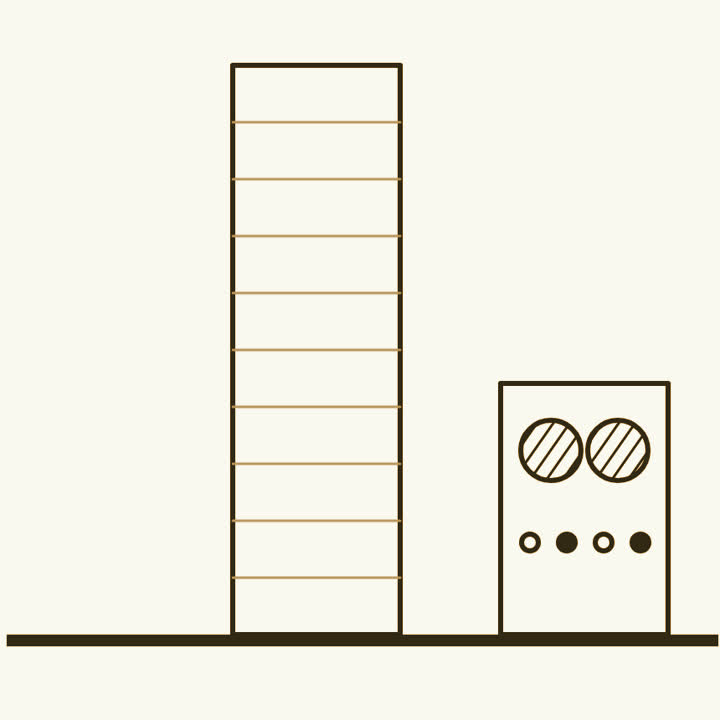
In the 1960s, Syukuro Manabe set out to build the climate inside a computer.
Manabe was a Japanese born meteorologist working in the United States. Computers were slow, so he started with the simplest model he could. He treated the atmosphere as a single column of air, from the ground to the top of the sky.
His column of air had to move heat in two ways at once.
Sunlight and invisible heat rays passed up and down through the layers. Warm air near the ground also rose, carrying heat upward, as it does on a summer afternoon. Getting both to work together was the key to a realistic column.
In 1967, with Richard Wetherald, he doubled the carbon dioxide in the model.
The air near the surface warmed by a little over two degrees. The air high above, in the stratosphere, cooled. That pattern is a fingerprint, because warming from a brighter Sun would heat both layers.
Later, Manabe and Wetherald built a model of the whole globe.
In 1975 it simulated the atmosphere around a simplified Earth, with winds, clouds and rain. It showed the far north warming faster than the rest of the planet. Much bigger computers would be needed to add real oceans, ice and land.
Decades later, the planet has behaved much as the early models said it would.
The lower atmosphere has warmed, and the stratosphere has cooled. The Arctic has warmed far faster than the global average. A 2019 study checked seventeen past model projections against what happened, and found most of them close.
In 2021, Manabe shared the Nobel Prize in Physics.
Half the prize went to Manabe and Klaus Hasselmann for the physical modelling of Earth’s climate. The other half went to Giorgio Parisi, for work on disorder in complex systems. Manabe was ninety years old.
So when a model makes a prediction, ask whether its past predictions came true.
A model is only a simplified copy of the world. Its value lies in whether what it predicts matches what is measured later. Manabe’s simple models passed that test decades after they were built. Starting simple, and checking against reality, is how a model earns trust.
Sources
- A Climate Model for the History Books, NASA Earth Observatory. Manabe and Wetherald’s 1967 model and why it mattered.
- How a 1967 study greatly influenced climate change science, Carbon Brief. A climate scientist explains what the 1967 paper got right.
- The Nobel Prize in Physics 2021, NobelPrize.org. The prize shared by Manabe, Hasselmann and Parisi.
Nearby ideas
- A year of sums about carbon dioxide. How a chemist with a pencil made the first estimate of global warming.
- The gases that trap heat. How two experiments showed that a few invisible gases keep the Earth warm.
- The first public weather forecasts. How a storm, a telegraph and a sea captain gave us the weather forecast.
- The rounded number that changed the forecast. How a rounded number revealed why the weather can't be forecast far ahead.
- The warm water that shifts the world’s weather. How warm water off Peru turned out to steer rain and drought around the world.