Cobra Effect · Weather and climate
The gases that trap heat
How two experiments showed that a few invisible gases keep the Earth warm.
7 cards, read aloud in 2:53, with a test and sources.
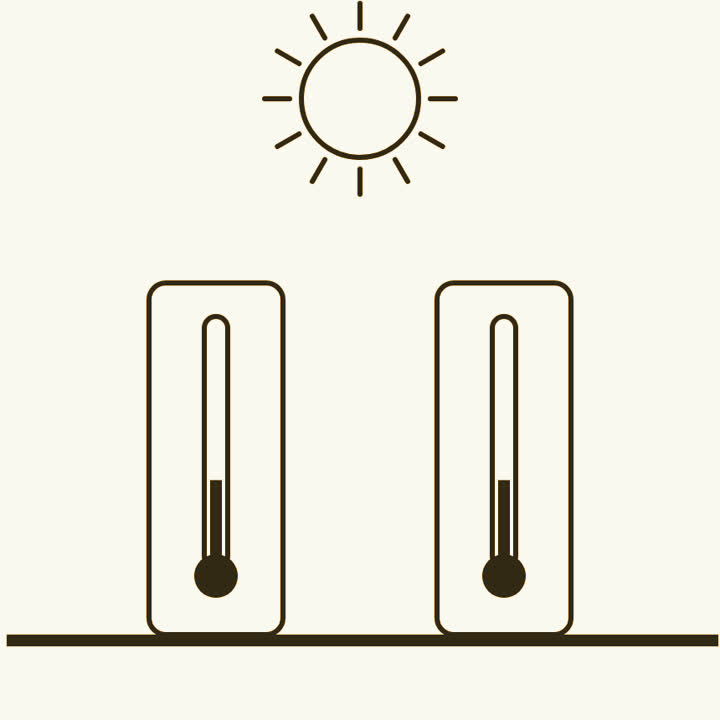
In 1856, Eunice Foote set two glass cylinders out in the sun.
Foote was an American scientist, and a campaigner for women’s rights. Each cylinder held a thermometer, and she could fill them with different gases. She compared dry air with moist air, and ordinary air with carbon dioxide, then called carbonic acid gas. Then she waited, and read the thermometers.
The cylinder of carbon dioxide grew hottest, and stayed hot longest.
Moist air also warmed more than dry air. Foote drew a bold conclusion. An atmosphere of that gas, she wrote, would give our Earth a high temperature. She suggested that if the air had once held more of it, the Earth would have been warmer.
Her paper was read at a science meeting in August 1856.
Joseph Henry, head of the Smithsonian Institution, presented it to the meeting. It was published that year, then largely forgotten for more than a century and a half. Historians still debate how widely it was noticed at the time.
Three years later in London, John Tyndall built a far more precise instrument.
At the Royal Institution, he sent invisible heat rays through a long tube filled with gas. A sensitive detector at the far end measured how much heat got through. Oxygen and nitrogen, the main gases of the air, let the heat pass almost freely. Water vapour and carbon dioxide absorbed it strongly.
Tyndall saw that water vapour wraps the Earth like a blanket.
Without it, he wrote, the ground would lose its warmth to space on a single clear night, and frost would kill tender plants. He wondered whether changes in the air might help explain the ice ages. He did not mention Foote’s work, and it is not known whether he had seen it.
These gases let sunlight in, but slow the escape of heat.
Sunlight warms the ground, and the warm ground gives off invisible heat rays. Water vapour and carbon dioxide absorb some of those rays, and send part of the heat back down. Without them, the Earth would be frozen. Adding more carbon dioxide thickens the blanket.
So when you hear that something invisible can warm a planet, ask how it was measured.
Foote used sunlight, glass and thermometers. Tyndall used a beam of heat and a detector that could register tiny differences. Both found the same gases at work. Two different experiments pointing the same way are stronger than either one alone.
Sources
- Who discovered the greenhouse effect?, Royal Institution. Foote, Tyndall and the question of who came first.
- Eunice Newton Foote’s nearly forgotten discovery, Physics Today. Her 1856 experiment and how it was rediscovered.
- First Paper to Link CO2 and Global Warming, by Eunice Foote (1856), The Public Domain Review. Foote’s original paper, reproduced in full.
Nearby ideas
- The curve that tracks carbon dioxide. How patient measurements on a Hawaiian volcano revealed carbon dioxide rising.
- Ancient air trapped in ice. How bubbles and layers in polar ice record hundreds of thousands of years of climate.
- A year of sums about carbon dioxide. How a chemist with a pencil made the first estimate of global warming.
- The first public weather forecasts. How a storm, a telegraph and a sea captain gave us the weather forecast.
- The rounded number that changed the forecast. How a rounded number revealed why the weather can't be forecast far ahead.
- The warm water that shifts the world’s weather. How warm water off Peru turned out to steer rain and drought around the world.
- The climate model that passed the test of time. How a simple computer model predicted climate change decades before it arrived.