Cobra Effect · Famous myths
Does old window glass flow downhill?
Why old window panes are uneven, and why it is not because glass flows.
7 cards, read aloud in 2:33, with a test and sources.
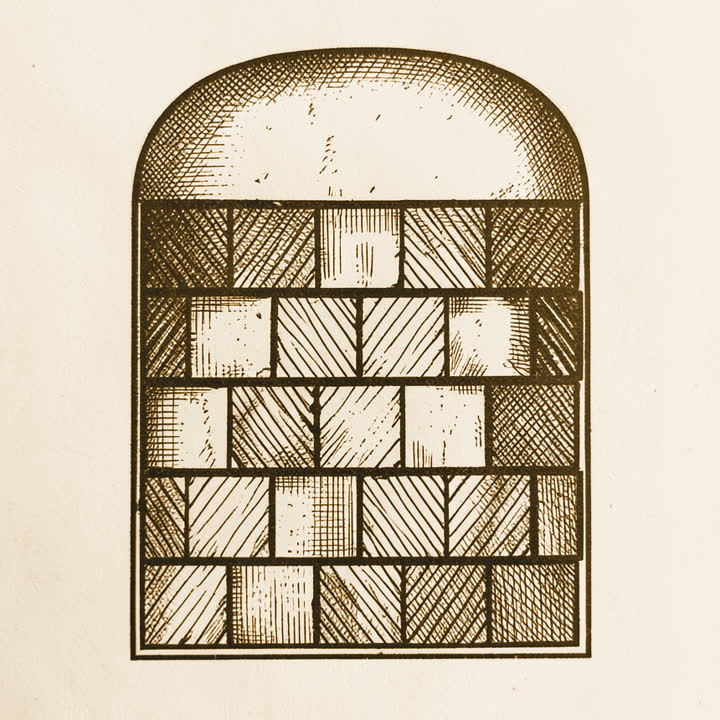
Old windows in churches and houses often have panes that are thicker at the bottom.
A popular explanation says that glass is really a very slow liquid. Over the centuries, the story goes, it has sagged downward under its own weight. The claim has been repeated by guides, teachers and even some textbooks.
In 1998, the materials scientist Edgar Zanotto calculated how fast old glass could flow.
He used the chemical makeup of medieval glass to estimate how stiff it is at room temperature. Even for a glass that flows more easily than medieval glass, visible sagging would take far longer than the age of the universe. He concluded that cathedral glass cannot flow noticeably at room temperature.
Ancient glass objects back him up.
Glass vases thousands of years old stand in museums with no sign of sagging. If glass flowed at room temperature, they would have slumped long ago.
The real reason old panes are uneven lies in how they were made.
Glassmakers spun molten glass into large discs, or blew it into long cylinders that were split open and flattened. Both methods produced sheets that were thicker in some places than in others. The ripples and thick edges were there from the day the glass was made.
And not every old pane is thicker at the bottom.
Surveys of old windows find many panes that are thicker at the top or at the sides. That fits panes that were uneven from the start, and fitted whichever way suited the glazier. Flowing glass would always gather at the bottom.
Glass is an unusual solid, which helps the myth survive.
Its atoms are arranged in a jumbled way, more like a frozen liquid than a crystal. But it behaves as a solid, and does not flow measurably at room temperature. The myth takes two true things, uneven panes and a liquid like structure, and joins them with a false cause.
So when a surprising fact explains what you see, ask what else would have to be true.
If glass flowed, every old pane would be thick at the bottom, and ancient vases would have slumped. Neither is true. The simpler explanation was in the glassmaker’s workshop all along.
Sources
- Do cathedral glasses flow?, Edgar Zanotto, American Journal of Physics, 1998. The calculation showing old glass cannot flow at room temperature.
- Glass, Wikipedia. Why glass is a disordered solid, and later studies of medieval glass.
- Is glass a liquid?, Glassnotes. How old panes were made, and how they were fitted.
Nearby ideas
- The tongue map that was never true. How a misread graph put a map of taste zones into school textbooks.
- Do we only use ten percent of our brains?. How a vague remark and a book foreword became the ten percent brain myth.
- Did Vikings wear horned helmets?. How horned Viking helmets came from an opera costume designer, not from history.
- Did Einstein fail maths?. How a real exam failure turned into the myth that Einstein failed maths.
- Was Napoleon really short?. How enemy cartoons and French inches made an average man famously short.
- Do goldfish really forget in three seconds?. What experiments show about goldfish memory, and the joke that got it wrong.
- Did tulip mania ruin the Dutch?. What the Dutch archives show about tulip mania, and how the story grew.