Cobra Effect · Famous myths
Do goldfish really forget in three seconds?
What experiments show about goldfish memory, and the joke that got it wrong.
7 cards, read aloud in 2:19, with a test and sources.
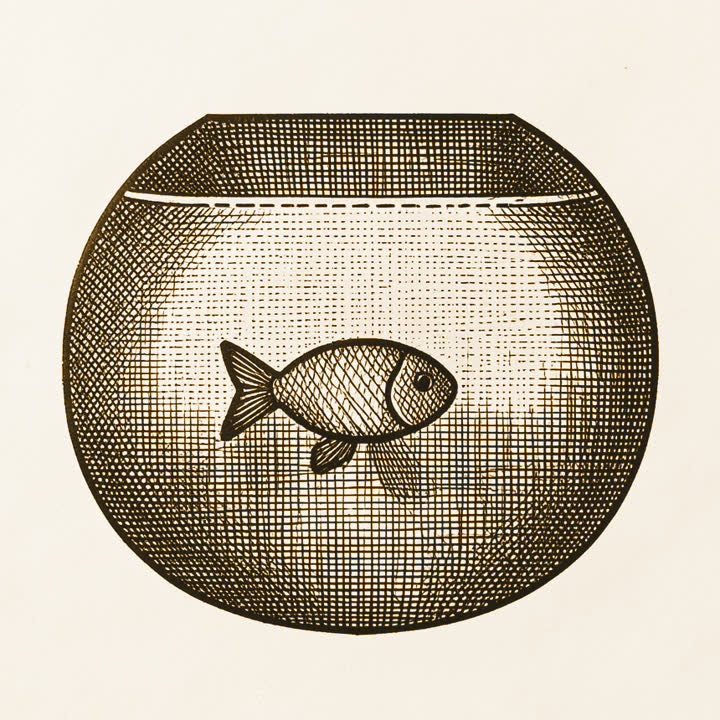
People often say a goldfish forgets everything within a few seconds.
It is a popular joke about short memories. Nobody has traced who first made the claim. Experiments show it is far from true.
In 1994, researchers trained goldfish to press a lever for food.
Food came during only one hour of each day, and the fish learned when that hour was. When the food stopped, they kept pressing around feeding time for several days. They kept time even when the lights stayed on constantly.
Goldfish were a favourite animal for memory research long before that.
In the 1960s, scientists studied how goldfish form memories of what they have learned, testing them days later. A fish that forgot in seconds would have been useless for those experiments. A television test later found goldfish remembering a route through a maze after more than a month.
Other kinds of fish have remembered for much longer.
Rainbowfish in one Australian study remembered how to escape a net almost a year after learning it. Salmon and trout have shown trained responses months later. Fish memory in general is far better than the joke suggests.
Fish are also better learners than many people think.
Reviews of fish behaviour find that their learning often matches that of other animals with backbones. That research has changed how some scientists think fish should be treated.
Some debunkings go too far the other way.
Claims that goldfish remember for years, or rival apes in intelligence, are not supported. Some popular figures, such as three months, do not match the studies they cite. What is well established is that goldfish remember what they learn for weeks, not seconds.
So when a joke becomes a fact, ask whether anyone ever tested it.
The three second claim has no known source. Simple experiments with a lever and a timer showed that it was wrong. A goldfish may well be waiting at the same spot every morning.
Sources
- Temporal discrimination learning of operant feeding in goldfish, Journal of the Experimental Analysis of Behavior, 1994. The lever study showing goldfish learn feeding times.
- Fish intelligence, Wikipedia. Memory studies across many kinds of fish.
- Goldfish, Wikipedia. Goldfish behaviour and learning.
Nearby ideas
- Do we only use ten percent of our brains?. How a vague remark and a book foreword became the ten percent brain myth.
- The man who could not make new memories. How one man's lost memory showed that remembering and learning skills are separate.
- Did tulip mania ruin the Dutch?. What the Dutch archives show about tulip mania, and how the story grew.
- The tongue map that was never true. How a misread graph put a map of taste zones into school textbooks.
- Does old window glass flow downhill?. Why old window panes are uneven, and why it is not because glass flows.
- Did Vikings wear horned helmets?. How horned Viking helmets came from an opera costume designer, not from history.
- Did Einstein fail maths?. How a real exam failure turned into the myth that Einstein failed maths.
- Was Napoleon really short?. How enemy cartoons and French inches made an average man famously short.