Cobra Effect · Space
The universe that is growing
How shifts in galaxies' light and their distances revealed that the universe is expanding.
7 cards, read aloud in 3:24, with a test and sources.
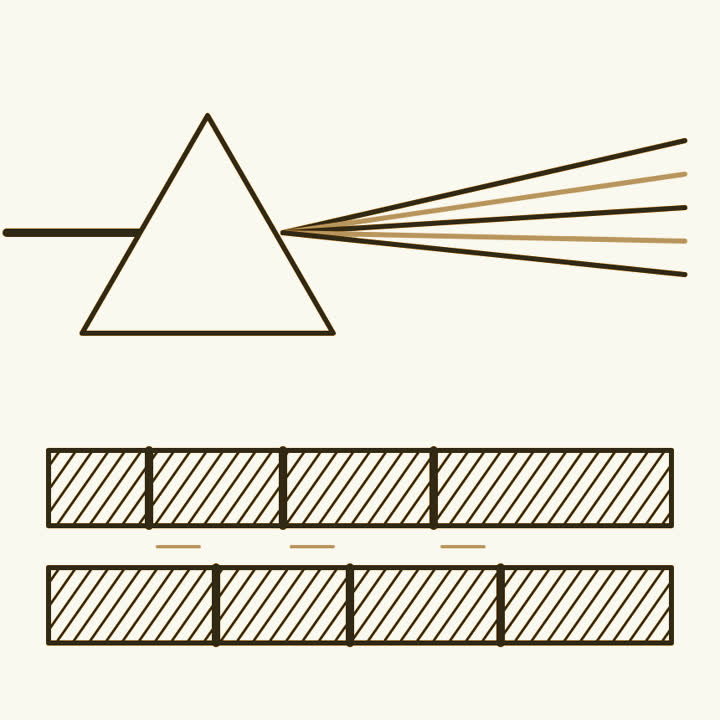
In the 1910s, Vesto Slipher found that most spiral nebulae are rushing away from us.
Slipher worked at Lowell Observatory in Arizona, spreading the light of faint nebulae into its colours. Light from something moving away is shifted toward the red end of the spectrum. Most of the spirals he measured showed a shift to the red, some of them very large. Nobody yet knew how far away these nebulae were.
In 1927 Georges Lemaitre proposed that the universe is expanding.
Lemaitre was a Belgian physicist, and a Catholic priest. He showed that Einstein’s theory of gravity allowed a universe that grows over time. Combining Slipher’s shifts with rough distances, he estimated how fast the universe was expanding. But he published in French, in a little-read Belgian journal, and few people noticed.
In 1929 Edwin Hubble showed that the farther away a galaxy is, the faster it recedes.
Hubble estimated the distances to galaxies using Cepheids and other methods. He paired his distances with speeds, most of them measured by Slipher. Plotted together, twenty four galaxies fell roughly along a line: the farther the galaxy, the faster it moved away. A galaxy twice as far away was receding about twice as fast.
The galaxies are not flying out from one centre. Space itself is stretching.
Imagine dots drawn on a balloon as it is blown up. Every dot moves away from every other, and dots that are farther apart separate faster. No dot is at the centre, and each one sees all the others moving away. That is just the pattern Hubble’s galaxies showed.
Run the expansion backwards, and the universe must once have been far smaller.
In 1931 Lemaitre suggested that the universe began in a single, extremely dense state. The idea grew into what is now called the Big Bang. Hubble’s first figure for the rate of expansion was about seven times too high, because his distances were too small. Better distances have brought the figure down, though different methods still do not quite agree.
In 2018, astronomers voted to add Lemaitre’s name to the rule of expansion.
The International Astronomical Union asked its members to vote on the name. Most voted to recommend calling it the Hubble Lemaitre law, to honour Lemaitre’s earlier work. Slipher’s measurements, which made both of their results possible, are often forgotten. Credit in science is not always shared out fairly at first.
So when everything seems to move away from you, ask whether you are really at the centre.
Observers in every galaxy would see the others receding, so this does not put us anywhere special. A pattern in shifts of light and distances revealed that space itself is growing. Astronomers are still refining the rate of expansion. Not every galaxy is moving away. Our neighbour Andromeda is heading toward us.
Sources
- Hubble’s law and the expanding universe, PNAS. Slipher, Lemaître and Hubble, and how the expansion was found.
- IAU members vote to recommend renaming the Hubble law, International Astronomical Union. The 2018 resolution adding Lemaître’s name.
- Georges Lemaître, father of the Big Bang, American Museum of Natural History. The priest and physicist who first described an expanding universe.
Nearby ideas
- The stars that measure the universe. How a pattern in pulsing stars gave astronomers a way to measure the universe.
- The hiss left over from the Big Bang. How a hiss in a radio antenna turned out to be the afterglow of the Big Bang.
- The galaxies that spin too fast. How galaxies spinning too fast revealed matter that no one can see.
- The first planet around a Sun-like star. How a star's tiny wobble revealed a giant planet where none was expected.
- The moons that circled Jupiter. How a few moving dots beside Jupiter challenged the old picture of the heavens.
- The planet found with pen and paper. How a planet straying off course led mathematicians to an unseen world.