Cobra Effect · Space
The galaxies that spin too fast
How galaxies spinning too fast revealed matter that no one can see.
7 cards, read aloud in 3:38, with a test and sources.
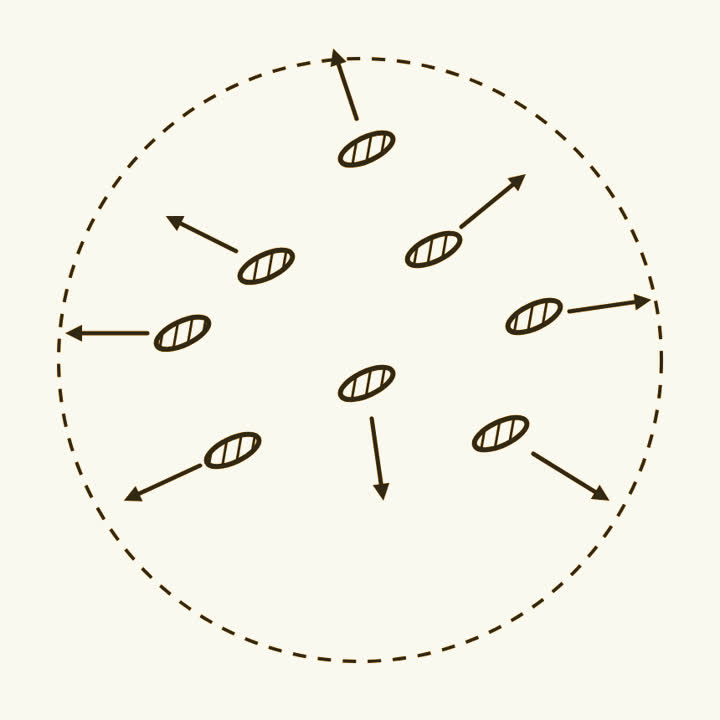
In 1933 Fritz Zwicky found galaxies in the Coma Cluster moving far too fast.
Zwicky was a Swiss astronomer working at Caltech, in California. He measured how fast the galaxies in a great cluster were moving about. They moved so fast that the matter he could see was not nearly enough to hold the cluster together. He suggested the cluster must contain a great deal of unseen matter. For decades, the idea was largely set aside.
Vera Rubin wanted to know how galaxies turn.
Rubin was an American astronomer at the Carnegie Institution in Washington. She worked with Kent Ford, who had built a sensitive new instrument for spreading faint light into its colours. Shifts in the light of glowing clouds of gas could show how fast each cloud was moving. In the late 1960s they measured clouds right across the Andromeda Galaxy.
Far from the centre, the gas was moving just as fast as it was nearer in.
In the solar system, outer planets orbit more slowly, because most of the mass is in the Sun at the centre. Most of a galaxy’s visible stars are crowded toward its middle, so its outer parts were expected to move more slowly too. Instead, the speeds stayed roughly level, far out from the centre. Rubin and Ford published their results for Andromeda in 1970.
Galaxy after galaxy showed the same flat pattern.
Through the 1970s, Rubin, Ford and their colleagues measured many more spiral galaxies. In 1980 they reported twenty one spirals of different sizes. Every one kept up its speed far from its centre. Rubin concluded that matter that gives off no light must exist beyond the visible galaxy. Radio astronomers measuring hydrogen gas far out in galaxies were finding the same thing.
Most of the matter in the universe seems to be invisible.
A galaxy spinning that fast needs far more mass than its stars and gas provide, or it would fly apart. The unseen mass is called dark matter. It gives off no light, and does not block it. Other evidence, from the way galaxy clusters bend light and from the afterglow of the Big Bang, points the same way. Nobody yet knows what dark matter is made of.
Rubin never won a Nobel Prize, but a great new observatory carries her name.
She was also a determined champion of women in astronomy. She received the National Medal of Science in 1993, and died in December 2016, aged eighty eight. The Vera C. Rubin Observatory in Chile released its first images in June 2025. It is surveying the southern sky, looking among other things for clues to dark matter.
So when something moves in a way you cannot explain, ask what you cannot see.
Rubin set out to measure how galaxies turn, not to find missing matter. Her careful measurements showed that what we can see is only part of what is there. A few scientists argue instead that gravity itself behaves differently across whole galaxies. What dark matter really is remains one of the biggest open questions in science.
Sources
- Vera Rubin publishes paper hinting at dark matter, American Physical Society. The measurements of Andromeda and the galaxies that followed.
- Who was Vera Rubin?, Carnegie Science. Her life, her science, and her work for women in astronomy.
- Rubin First Look, Vera C. Rubin Observatory. The first images from the observatory named in her honour.
Nearby ideas
- The hiss left over from the Big Bang. How a hiss in a radio antenna turned out to be the afterglow of the Big Bang.
- The universe that is growing. How shifts in galaxies' light and their distances revealed that the universe is expanding.
- The first planet around a Sun-like star. How a star's tiny wobble revealed a giant planet where none was expected.
- The moons that circled Jupiter. How a few moving dots beside Jupiter challenged the old picture of the heavens.
- The planet found with pen and paper. How a planet straying off course led mathematicians to an unseen world.
- The stars that measure the universe. How a pattern in pulsing stars gave astronomers a way to measure the universe.