Cobra Effect · Measurement
The kilogram that drifted
How the kilogram stopped being a lump of metal, and became a constant of nature.
7 cards, read aloud in 2:32, with a test and sources.
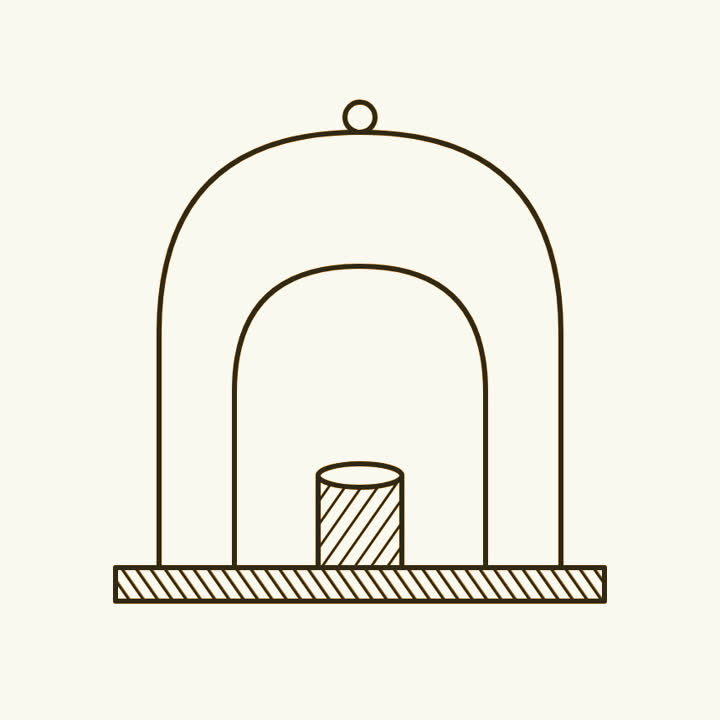
For a hundred and thirty years, the kilogram was a small metal cylinder kept near Paris.
It was cast in 1879 from platinum and iridium, and in 1889 it was declared to be the kilogram. Every other kilogram in the world was traced back to it. People called it Le Grand K.
Copies were made and sent around the world.
About forty national copies were handed out, and six official copies were kept alongside the original. From time to time, copies were brought back and compared with it.
The comparisons showed the copies and the original slowly drifting apart.
On average, the official copies gained about fifty micrograms over a century, compared with the original. That is a tiny amount, but a standard is supposed not to change at all. And because every check compared one object with another, nobody could tell which had really changed.
That left an awkward problem.
By definition, Le Grand K always had a mass of exactly one kilogram, whatever happened to it. If it lost a few atoms, the kilogram itself would change, and no check against it could ever show that.
So scientists decided to define the kilogram by a constant of nature instead.
In November 2018, an international conference voted to fix the value of the Planck constant exactly, and define the kilogram from it. The new definition took effect in May 2019. It was chosen so that a kilogram stayed the same size.
Two very different methods helped make the change possible.
A Kibble balance weighs a mass against an electromagnetic force, and links it to the Planck constant. Other teams made almost perfect spheres of silicon, and counted their atoms by measuring the spheres and their crystal structure. The constant defines the kilogram. Both methods are ways of putting that definition into practice.
So when a standard is an object, ask what happens if the object changes.
Le Grand K is still kept near Paris, but now it is measured, like everything else. A constant of nature cannot be scratched, cleaned or lost. Anyone with the right equipment can use it to check a kilogram.
Sources
- The kilogram, International Bureau of Weights and Measures. The official history of the kilogram’s definitions.
- The kilogram, past and present, National Institute of Standards and Technology. Le Grand K, its copies and the drift problem.
- The Kibble balance, National Institute of Standards and Technology. How a Kibble balance links mass to the Planck constant.
Nearby ideas
- The metre and the lumpy Earth. How two astronomers measured the metre, and why it came out slightly short.
- Weighing the Earth in a shed. How Henry Cavendish measured the density of the whole Earth from inside a shed.
- A metre made of light. How the metre went from a metal bar to the speed of light.
- The watch that found longitude. How a clockmaker solved longitude with a watch, and fought for years to be paid.