Cobra Effect · Measurement
A metre made of light
How the metre went from a metal bar to the speed of light.
7 cards, read aloud in 2:33, with a test and sources.
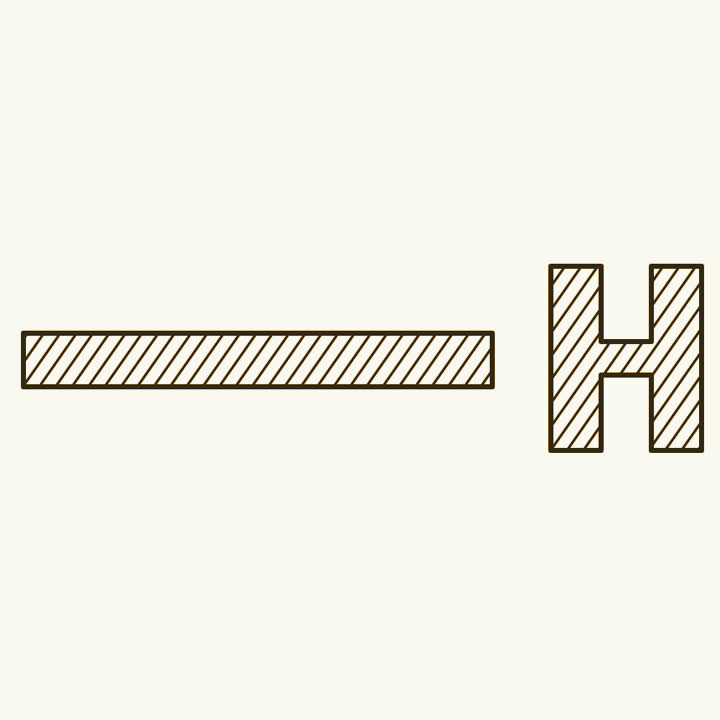
In 1889, the metre was redefined as the length of a new metal bar.
The international prototype metre was made of platinum and iridium, and kept near Paris. Its cross section had a special shape, designed to keep the bar stiff. Countries were given copies, and their own standards were checked against them.
But a bar can only be in one place, and it can be damaged.
Every precise length in the world depended on comparisons with that bar and its copies. Scientists wanted a standard that any well equipped laboratory could reproduce for itself.
In 1960, the metre was redefined using the light given off by krypton atoms.
Krypton atoms give off light of a very precise colour, with a very precise wavelength. The metre became a fixed number of those wavelengths, about one and two thirds million of them. For the first time, the metre was tied to atoms rather than to an object.
By the 1970s, the metre itself was the weak link in measuring the speed of light.
The main uncertainty in measuring it came from the krypton definition of the metre itself. So scientists turned the problem round.
In 1983, the metre became the distance light travels in a set fraction of a second.
In a vacuum, light covers one metre in just over a three hundred millionth of a second. The speed of light was fixed exactly, at two hundred ninety nine million, seven hundred ninety two thousand, four hundred and fifty eight metres per second. The metre now depends on the second, which is measured with atomic clocks.
Scientists did not measure the speed of light exactly in 1983. They defined it.
Before, the speed of light was something to be measured, with an uncertainty. After, it has no uncertainty at all, because the metre is built from it. Each new definition was chosen to match the old metre, so rulers did not change.
So when a standard holds back your measurements, ask what better thing could define it.
The metre moved from the size of the Earth, to a bar, to atoms, and then to light. Each step kept the length the same, while making it easier to reproduce anywhere.
Sources
- Resolution 1 of the 17th CGPM, 1983, International Bureau of Weights and Measures. The official resolution defining the metre by the speed of light.
- The metre, International Bureau of Weights and Measures. A timeline of every definition of the metre.
- Meter, National Institute of Standards and Technology. A plain language history of the metre.
Nearby ideas
- The metre and the lumpy Earth. How two astronomers measured the metre, and why it came out slightly short.
- Light takes time to arrive. How a moon of Jupiter and a spinning wheel showed that light takes time to arrive.
- The watch that found longitude. How a clockmaker solved longitude with a watch, and fought for years to be paid.
- The kilogram that drifted. How the kilogram stopped being a lump of metal, and became a constant of nature.
- Weighing the Earth in a shed. How Henry Cavendish measured the density of the whole Earth from inside a shed.