Cobra Effect · Measurement
The metre and the lumpy Earth
How two astronomers measured the metre, and why it came out slightly short.
7 cards, read aloud in 2:36, with a test and sources.
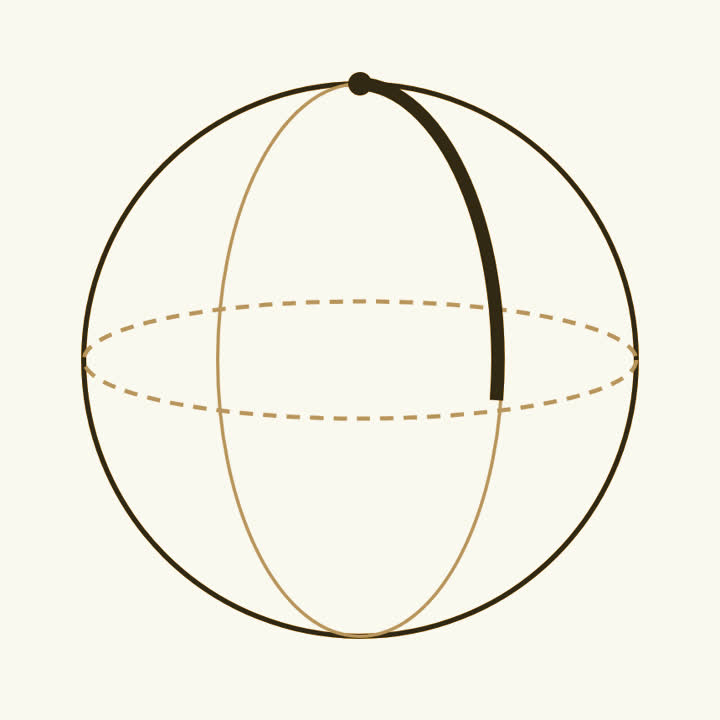
In 1791, French scientists decided that a new unit of length should come from the Earth itself.
The metre would be one ten millionth of the distance from the North Pole to the equator, measured along the line through Paris. Nobody could measure all of that, so they would measure part of it and work out the rest.
In 1792, two astronomers set out to measure the line from Dunkirk to Barcelona.
Jean Baptiste Delambre surveyed the northern part, and Pierre Mechain the southern part. They sighted from church towers and hilltops, measuring the angles between distant points. The fieldwork went on for six years, through the turmoil of the French Revolution.
In Barcelona, Mechain found that some of his own measurements did not agree.
Star sightings he had made to find his latitude disagreed with each other by a few seconds of arc. Fearing blame, he kept the problem secret, and it tormented him for years. He died of yellow fever in 1804, while trying to improve his measurements.
After Mechain’s death, Delambre found the problem, and kept the details quiet too.
The story stayed hidden for nearly two centuries. The historian Ken Alder uncovered it, and told it in his book The Measure of All Things, in 2002.
In 1799, a platinum bar was placed in the national archives to stand for the metre.
Its length was based on the survey, and on an assumed shape for the Earth. Later work showed the bar was about a fifth of a millimetre shorter than a true ten millionth of the distance.
Mechain’s hidden error was not the main reason the metre came out short.
Most of the gap came from the Earth itself, which is lumpier than any simple shape. Uneven rock and mountains pull a plumb line slightly off true, which throws off sightings of the stars. The surveyors’ own mistakes made up only a tiny share. And in practice it did not matter. Once the bar was made, the bar was the metre.
So when a measurement comes out wrong, ask whether the error is in the method or in the world.
Mechain blamed himself for a problem that was mostly the Earth’s. A careful measurement can still rest on an assumption that is not quite true. Finding out which one failed is part of the science.
Sources
- The measure of all things, Northwestern University. How Ken Alder discovered Mechain’s secret.
- Meter, National Institute of Standards and Technology. A short history of the metre from 1791 to today.
- The metre, International Bureau of Weights and Measures. The official history of the metre’s definitions.
Nearby ideas
- The watch that found longitude. How a clockmaker solved longitude with a watch, and fought for years to be paid.
- The kilogram that drifted. How the kilogram stopped being a lump of metal, and became a constant of nature.
- Weighing the Earth in a shed. How Henry Cavendish measured the density of the whole Earth from inside a shed.
- A metre made of light. How the metre went from a metal bar to the speed of light.