Cobra Effect · Statistics and probability
The law of large numbers
Averages settle down over many tries, but a run never gets corrected.
6 cards, read aloud in 2:28, with a test and sources.
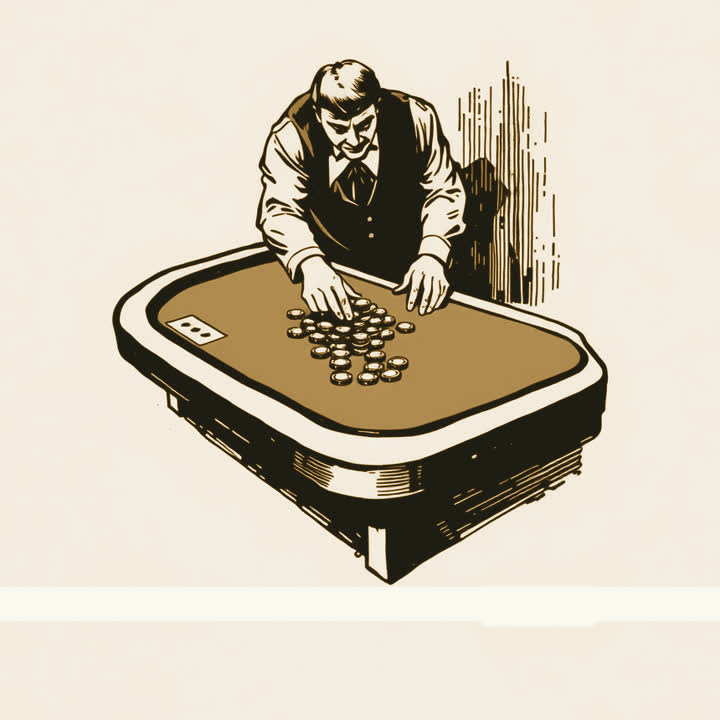
The casino lost money last night. It is not worried.
A man at the roulette table has just walked out with a year’s salary. Every spin is a game with a small edge to the house, and he beat it all evening. The manager smiles and pays. He knows something the winner does not.
Basel, 1713. A dead mathematician settles it.
Jacob Bernoulli spent twenty years on a proof and died before it was printed. His book, Ars Conjectandi, came out eight years after him. The theorem says that if you repeat a chance event enough times, the share of each outcome creeps ever closer to its true probability. He called it his golden theorem.
That is the law of large numbers.
Averages settle. Single events do not. On one spin the house edge is invisible. Anything can happen, and last night it did. Over a million spins, an edge of a few percent is a mountain nobody can climb. The casino is not betting against the man. It is betting on the year.
The law is misread more often than it is read.
It does not say a run of reds will be balanced by blacks. The wheel has no memory and owes nobody anything. The early run is not corrected. It is drowned. Ten reds in a row is a big deal in twenty spins and nothing at all in twenty thousand.
Insurers, pollsters and hospitals all live on it.
Nobody knows whose house will burn this year. The insurer knows roughly how many will. A survey of ten people tells you about ten people. A survey of a thousand tells you about the country, give or take. A tiny hospital has the best results in the region one year and the worst the next. The big one sits near the middle every year.
So ask how many.
Before you trust an average, ask how many events went into it. Before you trust a streak, ask how many events it took. Small samples produce wild averages, and wild averages produce confident stories. And if the game has an edge against you, stop while you are still an event, not yet an average.
Sources
- Ars Conjectandi, Wikipedia. Bernoulli’s book itself. His twenty years, the posthumous printing in 1713, and the pebbles in the urn that he used to explain it.
- The Drunkard’s Walk, Leonard Mlodinow, 2008. How randomness runs everyday life, with Bernoulli, the casinos and the streaks that were never streaks. The friendliest way into the maths.
- Law of large numbers, Wikipedia. The theorem, its weak and strong forms, and a clear section on what the law does not say about runs and corrections.
Nearby ideas
- The law of small numbers. Small samples swing wildly, and the swings look like signals.
- The gambler’s fallacy. Chance has no memory, so nothing is ever due.
- Regression to the mean. Extreme results drift back towards normal, whatever you do.
- Mean and median. Why the average can describe nobody at all.
- The Literary Digest poll. A small sample chosen well beats a huge one of the wrong people.
- The garden of forking paths. Choosing the analysis after seeing the data makes flukes look real.
- The Monty Hall problem. Why switching doors wins twice as often as staying put.
- The birthday problem. Coincidences are far more likely than they feel.