Cobra Effect · Microbes and the machinery of life
The little animals in a drop of water
How a Dutch cloth merchant with homemade lenses discovered a hidden world of life.
7 cards, read aloud in 2:42, with a test and sources.
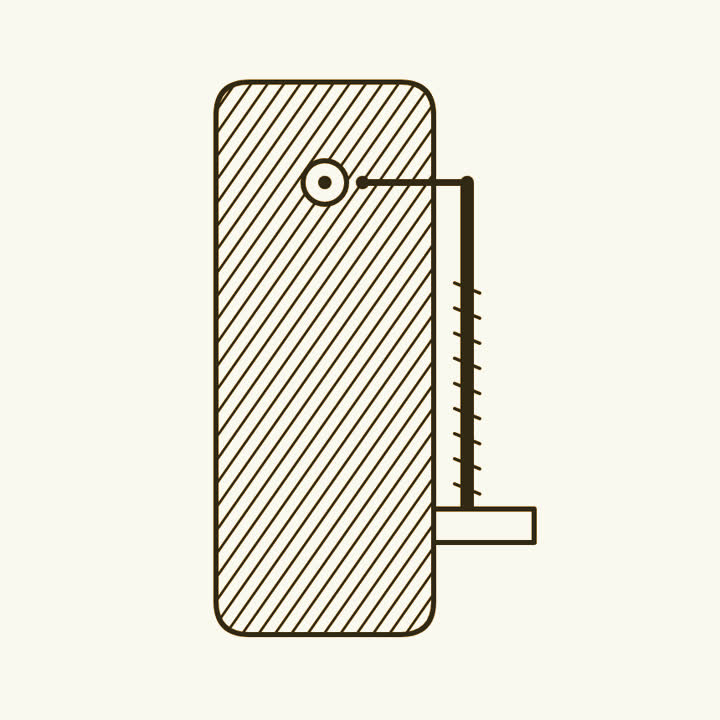
In the 1670s, a cloth merchant in Delft was building microscopes of his own.
Antonie van Leeuwenhoek had no university training. His microscopes had a single tiny glass lens, set in a metal plate small enough to hold in one hand. The best that survives magnifies about two hundred and seventy times, far more than other microscopes of his day. He never revealed exactly how he made his best lenses.
In 1674, he described tiny living creatures in lake water.
He wrote about them in a letter to the Royal Society in London. In his Dutch, he called them little animals. Hardly anyone had ever seen such things.
In 1676, he looked at water in which peppercorns had been soaking.
It swarmed with creatures far smaller than any he had seen. He reckoned that thousands of the smallest would scarcely equal one grain of sand. Most were single celled creatures, and at least one was probably a bacterium.
The Royal Society did not simply take his word for it.
He sent signed statements from respected local witnesses, including a minister and a notary. In 1677, Robert Hooke in London managed to see the creatures in pepper water himself. In 1680, Leeuwenhoek was elected a Fellow of the Royal Society.
In 1683, he scraped the white matter from between his teeth.
He also took samples from the mouths of two women, a child and several old men. He saw creatures of different shapes, some round, some like rods and some like spirals. His description is often counted as the first clear account of bacteria. More creatures lived in his mouth, he wrote, than there were people in the Netherlands.
He made no link between these creatures and disease.
That connection came nearly two centuries later. He kept observing into old age, and wrote hundreds of letters about what he saw. He died in 1723, and left a set of his microscopes to the Royal Society.
So when someone builds a better way to look, ask what no one has seen yet.
Leeuwenhoek was a merchant, not a professor. His lenses opened a world that had been there all along. And he let others check what he saw, which is why he came to be believed.
Sources
- Leeuwenhoek’s microscopes, Lens on Leeuwenhoek. Every surviving microscope, with its measured magnification.
- The unseen world: reflections on Leeuwenhoek, Nick Lane, Philosophical Transactions of the Royal Society B, 2015. A readable essay on the little animals letter.
- Antony van Leeuwenhoek, University of California Museum of Paleontology. A short biography.
Nearby ideas
- Germs do not come from nowhere. How a swan-neck flask and a country doctor proved that germs cause disease.
- The flasks with necks like swans. How a bent glass neck showed that microbes come from other microbes.
- Lightning in a flask. How sparks in a glass loop made some of the building blocks of life.
- The cells that took in bacteria. How a rejected idea showed that parts of our cells were once free living bacteria.
- The third branch of life. How comparing one molecule revealed a whole domain of life hiding in plain sight.
- The infection with no genes. How a brain disease in sheep led to infectious proteins with no genes at all.