Cobra Effect · Microbes and the machinery of life
Lightning in a flask
How sparks in a glass loop made some of the building blocks of life.
7 cards, read aloud in 2:42, with a test and sources.
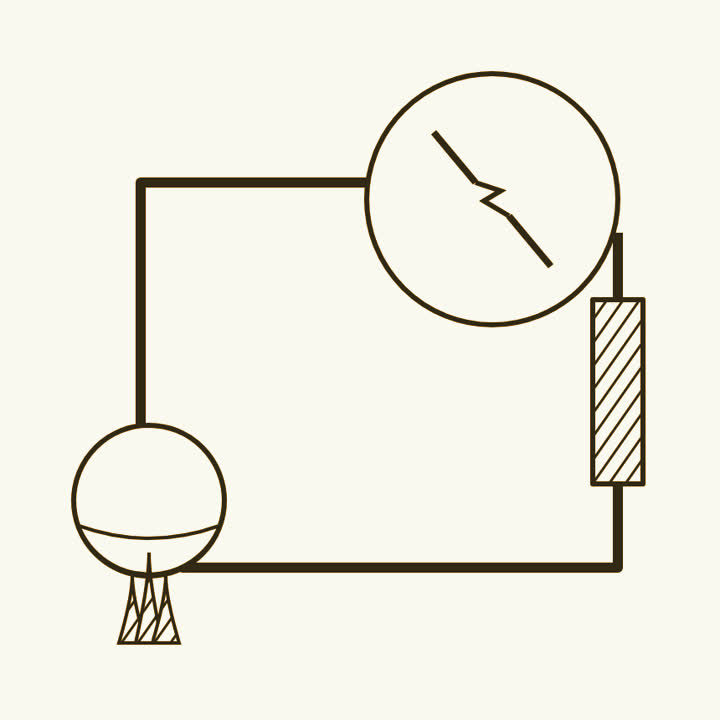
In 1952, a young graduate student tried to recreate the early Earth in glass.
Stanley Miller was studying at the University of Chicago, under the Nobel prize winning chemist Harold Urey. Urey thought the early atmosphere had been rich in gases such as methane, ammonia and hydrogen. Miller wanted to see what chemistry such an atmosphere might produce.
He built a closed loop of flasks and tubes.
Boiling water in one flask stood in for the ocean. Its vapour rose into a larger flask of gases, where electrodes made sparks, like lightning. A cooler turned the vapour back into liquid, which ran back to the start. He let it run for about a week.
The water slowly turned cloudy and reddish.
When Miller analysed it, he found amino acids, the building blocks of proteins. He reported a handful of them, including glycine and alanine. Simple gases and a source of energy had made some of the molecules of life.
In 1953, Miller published the result under his own name alone.
Urey declined to be listed as an author, so that his student would get the credit. The experiment became famous around the world. It showed that some building blocks of life can form without any living thing.
Decades later, scientists reanalysed sample vials Miller had kept.
In 2008, a team including Jeffrey Bada, once Miller’s student, tested them with modern instruments. Samples from the classic apparatus held fourteen amino acids. Samples from a version Miller never published, with a jet of steam like a volcano, held twenty two. Miller had died the year before.
But the early atmosphere may not have been what Urey imagined.
Many geologists now think it was mostly carbon dioxide and nitrogen, which gives far less in simple spark tests. Other experiments have found that building blocks can still form under some of those conditions. And making amino acids is a very long way from making a living cell.
So when an experiment recreates the past, ask how closely it matches the real past.
Miller’s result was real, and has been repeated many times. Its meaning depends on how much the early Earth resembled his flask. How life began is still an open question.
Sources
- ‘Lost’ Miller-Urey Experiment Created More Of Life’s Building Blocks, ScienceDaily, 2008. The reanalysis of Miller’s kept samples.
- Miller-Urey Revisited, NASA Astrobiology. What the steam jet version produced.
- Miller–Urey experiment, Wikipedia. The apparatus, the results, and later debate about the early atmosphere.
Nearby ideas
- The flasks with necks like swans. How a bent glass neck showed that microbes come from other microbes.
- The cells that took in bacteria. How a rejected idea showed that parts of our cells were once free living bacteria.
- The third branch of life. How comparing one molecule revealed a whole domain of life hiding in plain sight.
- The infection with no genes. How a brain disease in sheep led to infectious proteins with no genes at all.
- The little animals in a drop of water. How a Dutch cloth merchant with homemade lenses discovered a hidden world of life.