Cobra Effect · Microbes and the machinery of life
The cells that took in bacteria
How a rejected idea showed that parts of our cells were once free living bacteria.
7 cards, read aloud in 2:38, with a test and sources.
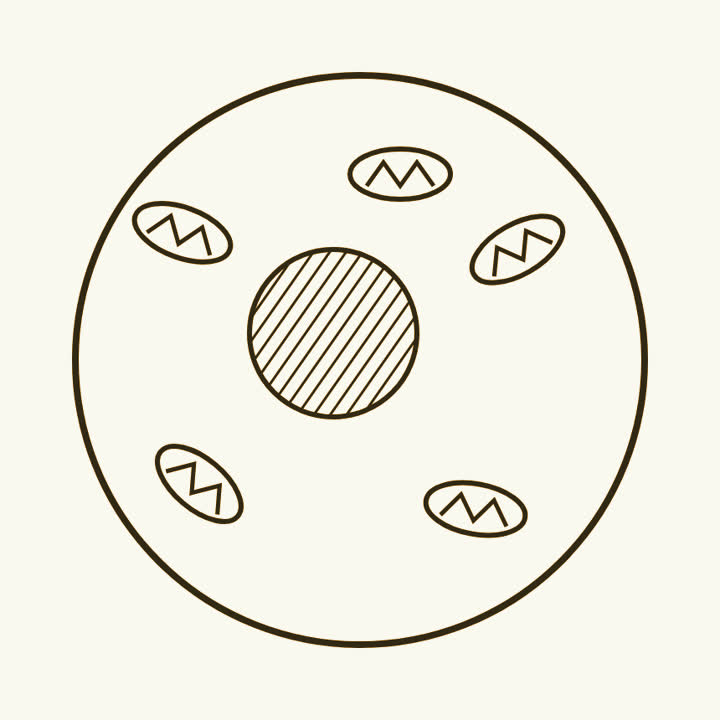
Inside your cells are tiny structures called mitochondria, which release energy from food.
Plant cells also have chloroplasts, which capture energy from sunlight. Both divide on their own, and carry small loops of their own DNA. By the early 1960s, scientists had found that DNA.
In 1967, Lynn Margulis argued that they had once been free living bacteria.
She was a young biologist at Boston University, publishing under her married name, Lynn Sagan. Long ago, she proposed, larger cells took in smaller bacteria that went on living inside them. Over a vast stretch of time, the partners became one.
The idea was not entirely new.
Early in the twentieth century, the Russian biologist Konstantin Mereschkowski had suggested that chloroplasts came from such partners. But most biologists had set the idea aside. Margulis gathered evidence from many fields to revive it.
By her own account, about fifteen journals rejected her paper.
It finally appeared in the Journal of Theoretical Biology. Many biologists thought the idea far fetched. Margulis kept arguing for it, loudly and persistently.
Then new ways of reading genes put the idea to the test.
From the late 1970s, scientists compared the genes of mitochondria and chloroplasts with those of bacteria. Mitochondria turned out to be closely related to one group of bacteria, and chloroplasts to another group called cyanobacteria. The evidence fitted Margulis’s idea.
Today, the bacterial origin of mitochondria and chloroplasts is widely accepted.
Not all her ideas fared so well. She also argued that the whip-like tails some cells use to swim came from bacteria, and that idea has not won support. Lynn Margulis died in 2011.
So when an idea is rejected, ask whether it was tested or simply disbelieved.
Margulis’s idea was dismissed long before it could be properly tested. When the evidence came, it supported her main claim, though not every part of it. Being right about one bold idea does not make every bold idea right.
Sources
- On the Origin of Mitosing Cells (1967), by Lynn Sagan, The Embryo Project Encyclopedia. What the 1967 paper proposed.
- Lynn Margulis, 1938–2011, Proceedings of the National Academy of Sciences. An obituary describing her work and her battles.
- Symbiogenesis, Wikipedia. The history of the idea and the evidence for it.
Nearby ideas
- The little animals in a drop of water. How a Dutch cloth merchant with homemade lenses discovered a hidden world of life.
- The third branch of life. How comparing one molecule revealed a whole domain of life hiding in plain sight.
- The infection with no genes. How a brain disease in sheep led to infectious proteins with no genes at all.
- The flasks with necks like swans. How a bent glass neck showed that microbes come from other microbes.
- Lightning in a flask. How sparks in a glass loop made some of the building blocks of life.