Cobra Effect · Microbes and the machinery of life
The infection with no genes
How a brain disease in sheep led to infectious proteins with no genes at all.
7 cards, read aloud in 2:50, with a test and sources.
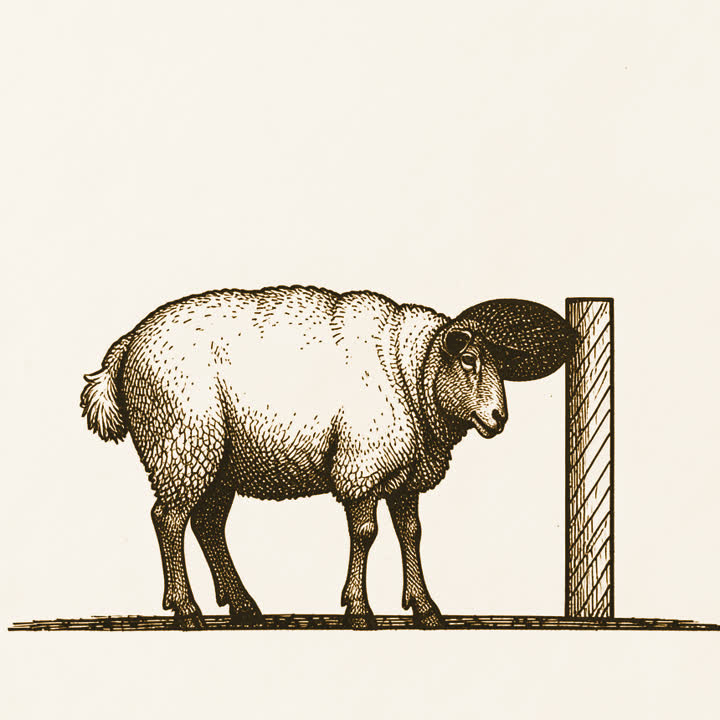
For centuries, sheep had suffered from a strange brain disease called scrapie.
Infected sheep scraped themselves against posts, staggered, and died. Among the Fore people of Papua New Guinea, a similar disease called kuru spread through funeral rites in which relatives’ bodies were eaten. Carleton Gajdusek showed that kuru could be passed on, and shared a Nobel Prize in 1976.
Whatever caused these diseases behaved very strangely.
It took years to cause illness, so it was thought to be a slow acting virus. But in the 1960s, experiments showed it survived treatments that destroy DNA and RNA. A few scientists suggested the infectious agent might be made of protein alone.
In 1972, Stanley Prusiner began to hunt for the cause.
He was a young neurologist in San Francisco, and a patient of his had died of Creutzfeldt-Jakob disease. He spent years purifying the infectious material from scrapie. What remained seemed to be protein, with no genes of its own.
In 1982, he gave the agent a name, prion.
The name came from the words proteinaceous infectious particle. He argued that a misfolded form of a normal protein could make normal copies fold the wrong way too. Many scientists thought the idea was heresy, since every known infection involved genes.
In the 1990s, prion diseases became front page news.
Britain faced an epidemic of mad cow disease, a prion disease of cattle. In March 1996, the government announced that a new form of the human disease was probably linked to eating infected beef. In 1997, Prusiner received the Nobel Prize in Physiology or Medicine.
The idea is now widely accepted, though its details are still studied.
Prions are not alive. They are proteins folded into the wrong shape. Some critics argued for a hidden virus long after the Nobel Prize. Researchers are exploring whether misfolded proteins spread in a similar way in other brain diseases, but that remains unproven.
So when a discovery breaks a rule everyone accepts, ask what the evidence actually shows.
Every known infection had involved genes, until this one seemed not to. Prusiner followed the evidence in the face of heavy doubt. Rules in science are summaries of what has been seen so far.
Sources
- Prions, University of Utah, Learn.Genetics. How prions work, and the diseases they cause.
- Etymologia: Prion, Emerging Infectious Diseases, US Centers for Disease Control and Prevention. Where the word came from, and the 1982 paper.
- Prion, Wikipedia. The history of the idea and the diseases involved.
Nearby ideas
- The third branch of life. How comparing one molecule revealed a whole domain of life hiding in plain sight.
- Germs do not come from nowhere. How a swan-neck flask and a country doctor proved that germs cause disease.
- The little animals in a drop of water. How a Dutch cloth merchant with homemade lenses discovered a hidden world of life.
- The flasks with necks like swans. How a bent glass neck showed that microbes come from other microbes.
- Lightning in a flask. How sparks in a glass loop made some of the building blocks of life.
- The cells that took in bacteria. How a rejected idea showed that parts of our cells were once free living bacteria.