Cobra Effect · Everyday machines
How messages cross the internet in pieces
How messages cross networks as small pieces that each find their own way.
7 cards, read aloud in 2:44, with a test and sources.
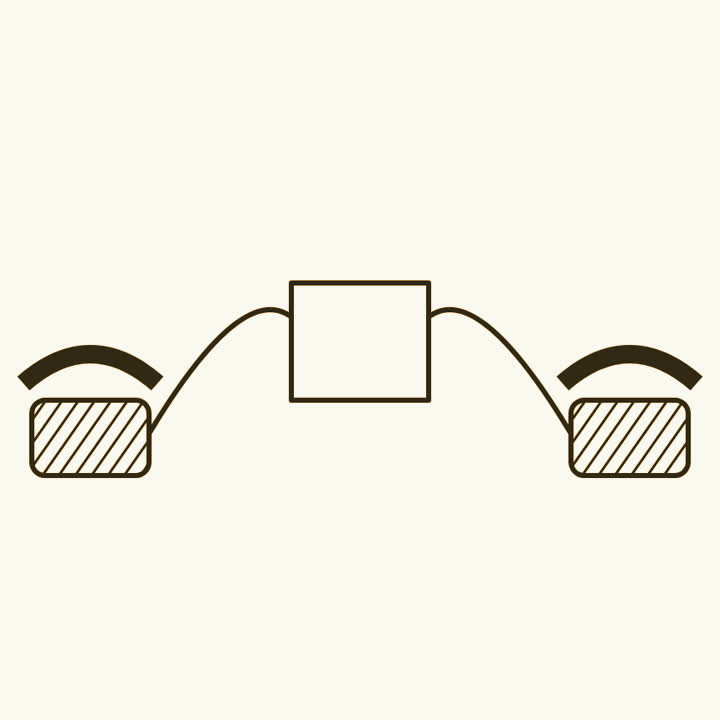
In the early 1960s, a telephone call held a whole line open for as long as it lasted.
While a call went on, that path belonged to it alone, even during the silences. The system depended on central exchanges, and losing a key one could cut many calls at once. Two engineers, working separately, found a very different way to send messages.
At the RAND Corporation in America, Paul Baran designed a network meant to survive an attack.
Worried about nuclear war, he proposed a mesh of many links with no central hub. Messages would be cut into blocks that each found their own way, and were put back together at the end. He published the idea in a series of reports in 1964, but it was not built.
In Britain, Donald Davies came up with the same idea in 1965, for a different reason.
He wanted many people to share expensive computers quickly and cheaply. He called the pieces packets, choosing a word that would translate easily into other languages. He learned of Baran’s work only after making his own proposal.
Packets share the lines, and each one can take its own route.
A message is split into small pieces, each carrying its address and its place in the order. Switches along the way pass each packet on toward its destination, sending it round busy or broken links. At the far end, the pieces are put back together in order.
In October 1969, the first message crossed a new American network called ARPANET.
A student programmer at UCLA tried to log in to a computer at the Stanford Research Institute. The system crashed after two letters, so the first message was lo. Soon afterwards, the login worked.
A popular story says the internet was built to survive a nuclear war.
That was true of Baran’s design, but not of ARPANET. The director of the agency behind it later said it was started so that researchers could share computers. Davies, too, was thinking about sharing computers, not about war.
So when a network keeps working after a link fails, ask how the pieces found another way.
Emails, videos and web pages still travel as packets. No single path has to survive for a message to arrive. Two people found the idea independently, for two different reasons.
Sources
- Donald Davies, Internet Hall of Fame. The man who named the packet.
- Internet history of the 1960s, Computer History Museum. A timeline including the first ARPANET connection in 1969.
- ARPANET, Wikipedia. The first message, and what the network was really for.
Nearby ideas
- The man who measured information. How Claude Shannon turned information into something that could be measured in bits.
- The codes that fix their own mistakes. How a frustrated mathematician invented codes that find and fix their own errors.
- How the barcode got from the beach to the checkout. How a pattern drawn in beach sand became the code on almost everything you buy.
- How a battery learned to carry lithium safely. How three scientists made a rechargeable battery that carries lithium safely.
- How a jet engine pushes a plane forward. How a jet engine drives a plane forward by throwing gas backward.
- How a touchscreen knows where you touched. How touchscreens sense your finger, and the decades of work behind them.
- The microwave oven and the melted snack bar. What the records show about how the microwave oven was invented, and how it heats.
- How GPS finds you by timing light. How GPS works out where you are by timing light, and allowing for relativity.