Cobra Effect · Everyday machines
How GPS finds you by timing light
How GPS works out where you are by timing light, and allowing for relativity.
7 cards, read aloud in 2:52, with a test and sources.
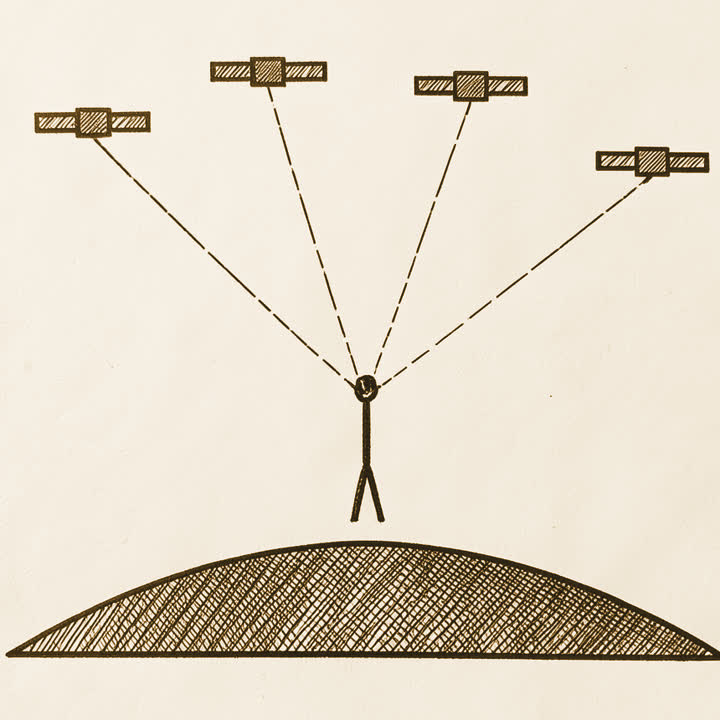
A GPS receiver finds its place on Earth by timing signals from satellites.
Each satellite carries atomic clocks, and keeps broadcasting the time and its own position. The receiver notes when each signal arrives, and works out how long it spent travelling. Radio signals travel at the speed of light, so each delay gives a distance.
With distances to several satellites, only one place fits.
A distance from one satellite puts you somewhere on a huge sphere around it. Distances from more satellites narrow that down to a single point. The receiver needs at least four, because it also has to work out the error in its own cheap clock.
The timing has to be extraordinarily precise.
Light travels about thirty centimetres in a billionth of a second. So a clock error of a billionth of a second means an error of about thirty centimetres in distance. That is why the satellites carry atomic clocks, and why ground stations keep checking them.
The system grew out of American military navigation projects of the 1960s.
Programmes run by the US Navy and Air Force were merged into GPS in 1973. In 1977, a Navy test satellite carried the first caesium atomic clock into orbit. The first experimental GPS satellite followed in 1978.
Clocks in orbit do not keep the same time as clocks on the ground.
Gravity is weaker up there, which makes the satellite clocks run faster, by about forty five millionths of a second a day. Their speed makes them run slower, by about seven millionths. Some doubted the effect would matter, so the 1977 test clock carried a way to switch on a correction after launch.
In orbit, the test clock ran fast by almost exactly the amount Einstein’s theories predicted.
Its rate matched the prediction to within about one percent. Today every GPS satellite clock is set before launch to tick slightly slow, so that in orbit it keeps pace with the ground. Receivers add a small extra correction for each satellite’s slightly oval orbit.
So when a gadget knows where you are, ask what it had to get right.
Your position comes from timing light to within billionths of a second. Uncorrected, the satellite clocks would gain about thirty eight millionths of a second a day, time enough for light to travel about eleven kilometres. Allowing for gravity and speed is built into the system from the start.
Sources
- Relativity in the Global Positioning System, Neil Ashby, Living Reviews in Relativity. The standard account of the corrections, including the 1977 test.
- Error analysis for the Global Positioning System, Wikipedia. The relativity corrections and the frequency set before launch.
Nearby ideas
- Gravity slows time. Why clocks run slower in stronger gravity, and why GPS has to allow for it.
- Moving clocks run slow. Why moving clocks run slow, and how muons and airliners proved it.
- Why a bright blue light took thirty years. How two teams made the bright blue LED that white LED lighting depends on.
- How a fridge moves heat out of a box. How a fridge carries heat out of a box, using a liquid that boils and condenses.
- How messages cross the internet in pieces. How messages cross networks as small pieces that each find their own way.
- How the barcode got from the beach to the checkout. How a pattern drawn in beach sand became the code on almost everything you buy.
- How a battery learned to carry lithium safely. How three scientists made a rechargeable battery that carries lithium safely.
- How a jet engine pushes a plane forward. How a jet engine drives a plane forward by throwing gas backward.